Most Attractive Face Shape: What Research and Style Really Show
A practical comparison of oval, heart, diamond, square, round, and oblong faces—without pretending one outline defines beauty.

Written By
Clara Vale
Beauty technology writer focused on explaining face analysis, proportions, and photo feedback without turning appearance into a rigid score.
Editorial Note
Face shape describes the outer contour of a face. It does not measure health, character, worth, or universal attractiveness.
Quick answer: which face shape is most attractive?
There is no single most attractive face shape for every person, gender, or culture. Oval faces are often described as balanced and styling-friendly, heart and diamond faces are frequently praised for cheekbone definition, and square faces can read as strong or sculpted. Those are tendencies in beauty media and some preference studies, not universal rules.
The better answer is that an attractive face shape is one that works with the eyes, nose, lips, jaw, skin, expression, and overall proportions. A clear photo, natural smile, suitable hairstyle, and confident presentation can change perceived attractiveness more than the label attached to the outline.
What “most attractive face shape” really means
When people search for the most attractive face shape, they often want a clear winner: oval, heart, diamond, square, round, or oblong. The problem is that a face-shape label reduces a three-dimensional face to the outline seen in one front-facing image. It leaves out feature spacing, profile, cheek volume, skin, movement, and expression.
Face shapes also blend. Someone may have an oval outline with a square jaw, a heart-shaped upper face with a rounded chin, or an oblong face that looks oval when they smile. Hairstyle, facial hair, camera distance, and body composition can change the apparent category without changing the underlying bone structure.
So the useful version of the question is not “Which category always wins?” It is “Which contours and proportions tend to look balanced in a given face, and how can I present my own shape clearly?” That framing gives practical answers without turning a flexible classification into a beauty verdict.
Four ideas to keep separate
- Face shape: The outer contour created by forehead, cheekbones, jaw, and chin.
- Facial proportions: Distances and relationships among features inside that contour.
- Facial symmetry: How similar the visible left and right sides appear in one image.
- Facial harmony: How shape, features, spacing, and expression work together as a whole.
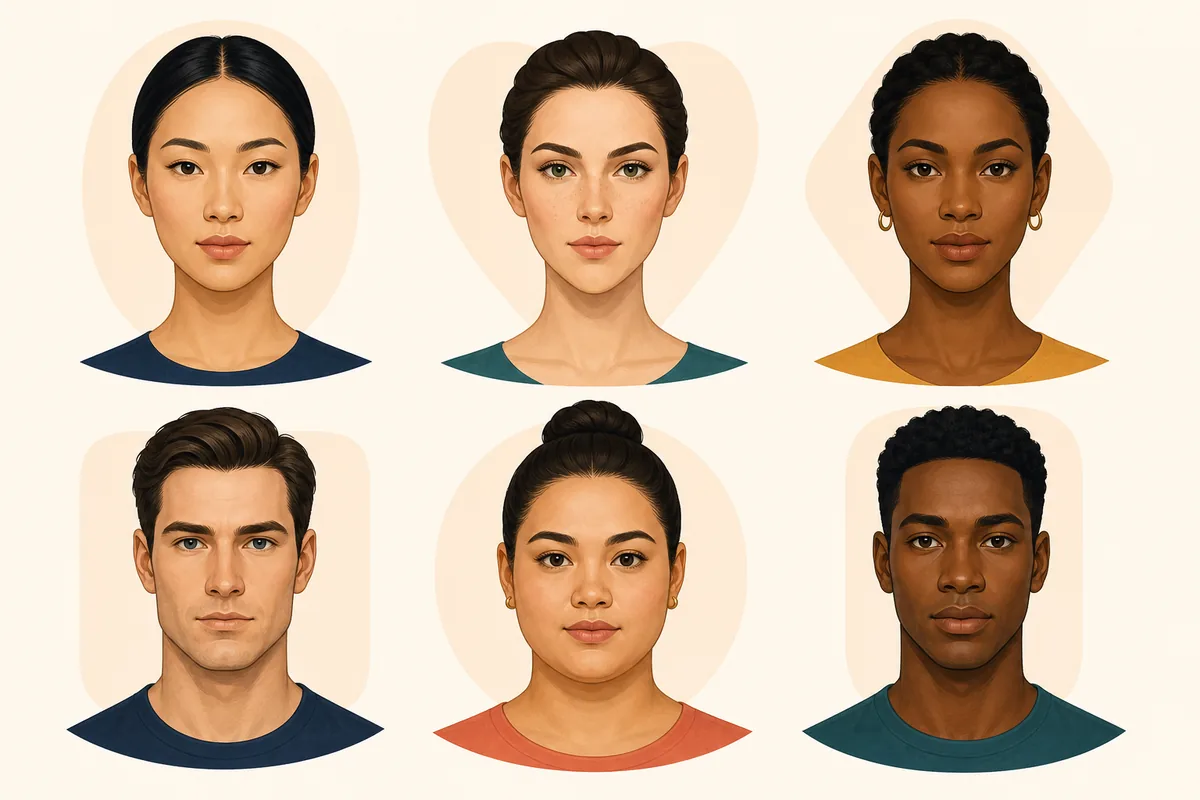
Oval, heart, diamond, square, round, and oblong faces compared
Oval is often called the most versatile face shape because the forehead is usually a little wider than the jaw and the length is greater than the width. That balance makes many hairstyles and glasses easier to fit. Versatile, however, does not mean objectively more beautiful.
Heart and diamond faces draw attention to the cheekbones and narrower chin. Square faces have a broader, more angular jaw that can read as strong, mature, or striking. Round faces create softer curves and a youthful impression. Oblong faces emphasize vertical length and can look elegant or sculptural.
None of these descriptions predicts attractiveness by itself. The same square outline can look very different with softer eyes, fuller cheeks, or a longer nose. The same oval outline can read differently depending on hairline, chin projection, smile, and camera angle. Use the comparison as a vocabulary for contours, not a ranking.
A recent three-dimensional facial morphology study found measurable shape tendencies associated with higher attractiveness ratings, while also showing that the patterns differed between male and female faces; read the open-access study in Progress in Orthodontics For a broader review of symmetry, averageness, and sexual dimorphism, see the Annual Review of Psychology overview.
| Face shape | Typical contour | Useful interpretation |
|---|---|---|
| Oval | Longer than wide, softly tapered jaw | Often versatile for hair and frames; not automatically more attractive. |
| Heart | Wider forehead, prominent cheeks, narrower chin | Can emphasize cheekbones and upper-face width. |
| Diamond | Cheekbones widest, narrower forehead and jaw | Creates angular cheek emphasis and a sculpted outline. |
| Square | Similar forehead and jaw width with stronger angles | Can read as strong, structured, or dramatic. |
| Round | Similar length and width with curved jaw | Often reads as soft, open, or youthful. |
| Oblong | Clearly longer than wide with straighter sides | Can read as elegant, lean, or sculptural. |
What research can—and cannot—say about attractive face shape
Research can compare how groups rate standardized images and identify shape features that correlate with those ratings. The 2026 three-dimensional study linked higher ratings with narrower facial width, slightly longer shape, reduced cheek volume, and more projected central structures in its sample. Male and female patterns were not identical, which already argues against one universal outline.
Correlation is not a prescription. A finding from one sample does not prove that everyone should have a narrow or longer face, and it cannot tell an individual which haircut, photo, or expression will suit them. Ratings also depend on the faces included, who did the rating, image quality, age range, and cultural context.
Older attractiveness research often highlights averageness, symmetry, and sex-typical cues. These are broader relationships than the familiar salon categories of oval or diamond. A face can be rated attractive because its features work together even when its outline does not fit a supposedly ideal category.
The most responsible conclusion is modest: contour matters, but it works alongside many other signals. Science can describe group-level patterns; it cannot award one face-shape label a permanent global crown.
| Variable | What it can change | Better check |
|---|---|---|
| Close wide-angle selfie | Makes the center larger and edges recede | Move farther away and use a modest zoom. |
| High camera angle | Emphasizes forehead and narrows the jaw | Keep the lens near eye-to-nose height. |
| Three-quarter turn | Makes the face look narrower | Use a front view for classification. |
| Hair and beard | Hides or redraws the outer contour | Check once with the jaw and hairline visible. |
| Smile | Raises and widens the cheeks | Use a relaxed mouth for measurement. |
The most attractive face shape for men, women, and different cultures
For men, square or angular jaws are often described as attractive because they can signal strength and maturity, while oval and oblong faces are praised for balanced or refined proportions. Yet a broad jaw is not automatically better: its effect depends on cheek width, chin, brow, hairstyle, beard shape, and expression.
For women, heart, diamond, and oval faces appear often in beauty-media rankings. Heart and diamond outlines emphasize cheekbones and a narrower lower face, while oval is treated as versatile. These labels reflect fashion and cultural narratives as much as biology, and they change across places and decades.
Local ideals matter. Some East Asian beauty discussions favor a small face or V-shaped lower contour, while many Western style guides celebrate either a sculpted jaw or an oval silhouette. Individual preference is wider than any trend. A person attracted to softness may prefer round contours; someone drawn to angularity may prefer square or diamond shapes.
That is why this guide does not rank one category from best to worst. The honest comparison is context-based: which outline supports the rest of the face, and which styling choices make that structure readable without erasing individuality?
| Context | Often praised | Why this is not a rule |
|---|---|---|
| General styling | Oval for versatility | Versatility describes styling options, not beauty value. |
| Women's beauty media | Heart, diamond, or oval | Trends and celebrity examples influence the label. |
| Men's grooming media | Square, oval, or oblong | Jaw definition is only one part of the full face. |
| East Asian trends | Small or V-shaped lower face | Regional ideals do not represent every individual. |
| Personal attraction | Any shape | Expression, familiarity, style, and chemistry can dominate contour. |
How to identify your face shape without letting the camera mislead you
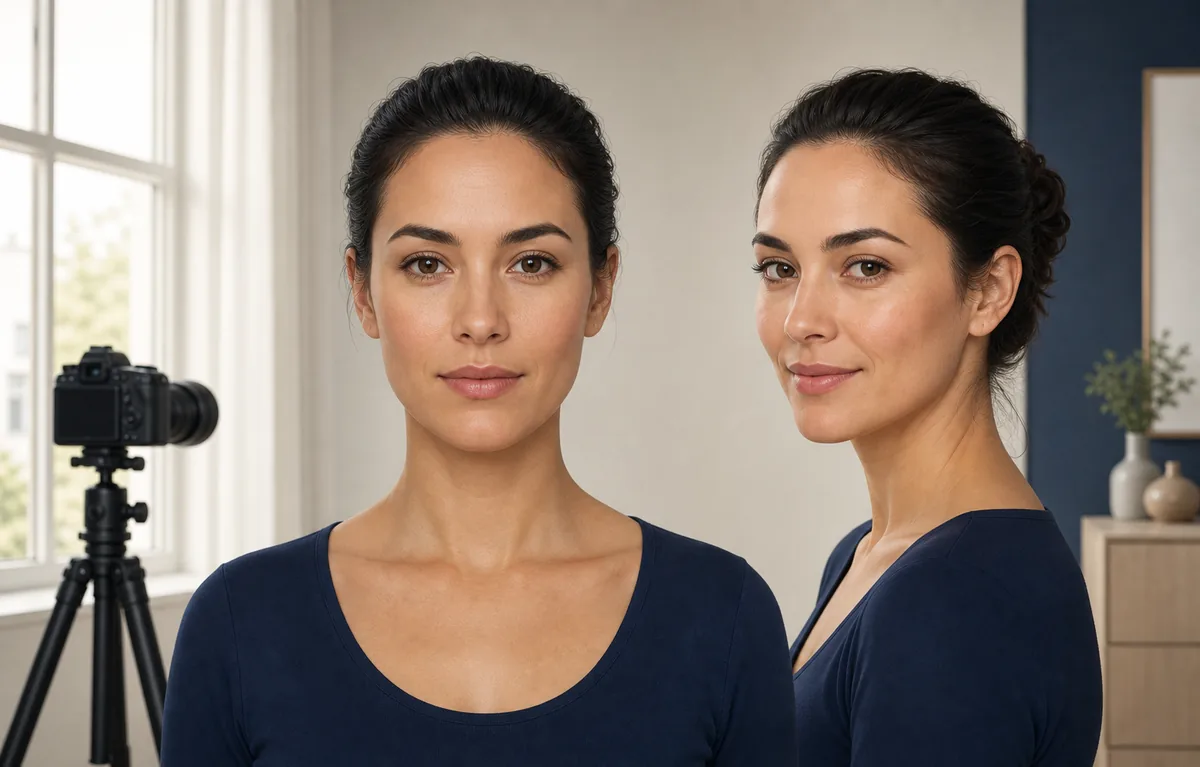
Start with a front-facing photo taken from farther away than a typical arm-length selfie. Keep the camera level with the middle of the face, use soft frontal light, pull hair away from the forehead, and use a relaxed expression. This makes the hairline, cheekbones, jaw, and chin easier to compare.
Look for relationships rather than forcing an instant label. Is the face clearly longer than it is wide? Which area is widest: forehead, cheekbones, or jaw? Does the jaw look angular or curved? Is the chin broad, rounded, or pointed? Those observations are more reliable than tracing a perfect geometric shape around the photo.
Repeat the check with two neutral photos. A wide-angle selfie can enlarge the center of the face; a slight turn can narrow one side; a smile can widen the cheeks; and loose hair can hide jaw width. If two categories still seem plausible, use a mixed description such as oval-square or heart-round.
A cleaner face-shape check
- Use camera distance: Step back and zoom slightly instead of holding a wide-angle phone close.
- Keep the lens level: A high or low camera angle changes forehead and jaw emphasis.
- Show the full contour: Move hair away from the temples, cheeks, and jawline.
- Compare widths: Notice forehead, cheekbone, and jaw widths before naming a category.
- Allow a mixed result: Many real faces combine two familiar shape patterns.
How to make your face shape work in photos and styling
The most useful styling goal is balance, not disguise. Hair can add width beside an oblong face, create vertical movement around a round face, soften a square jaw, or keep volume away from already prominent cheekbones. These are visual choices, not rules about what you must hide.
Glasses work similarly. Frame width, bridge position, and lens scale often matter more than a simple “opposites attract” rule. A round face can wear round frames when the size fits; a square face can wear angular frames when the proportions feel deliberate. Try several sizes in consistent lighting before judging the shape alone.
For photos, test one centered portrait and one gentle three-quarter angle. Keep camera distance, light, and expression similar so you can see what the angle changes. The stronger image is usually the one that preserves your proportions, keeps both eyes readable, and shows the jaw without distortion.
If you use an AI attractiveness test, compare photographs rather than treating the result as a diagnosis of your face shape. A score change may reflect lighting, crop, or expression. Combine that feedback with the face symmetry test and facial harmony guide to understand why one image reads more clearly.
A practical workflow
- Name the contour: Choose the closest one or two shape families without forcing precision.
- Notice the whole face: Include feature spacing, cheek volume, jaw, and expression.
- Test presentation: Compare hair, frames, facial hair, and two controlled photo angles.
- Use scores carefully: Treat AI output as photo feedback, not a permanent beauty label.
- Keep individuality: The goal is a coherent presentation, not copying somebody else's outline.
Most attractive face shape FAQ
Compare how your face reads in a real photo
Use one clear front-facing portrait to check overall presentation, then compare it with a second well-lit photo. Focus on consistent camera distance and expression rather than chasing a supposedly perfect outline.
The AI test can help compare images, while the face symmetry tool separates left-right balance from face-shape labels.
Research notes
- Gkantidis et al. (2026), Influence of facial shape on perceived attractiveness, Progress in Orthodontics.
- Rhodes (2006), The evolutionary psychology of facial beauty, Annual Review of Psychology.
- Face-shape categories in this guide are descriptive styling conventions, not medical classifications.