Am I Conventionally Attractive? Meaning & Better Questions
A grounded guide to conventional beauty standards, visible cues, personal context, and the limits of turning appearance into a score.
Editorial Note
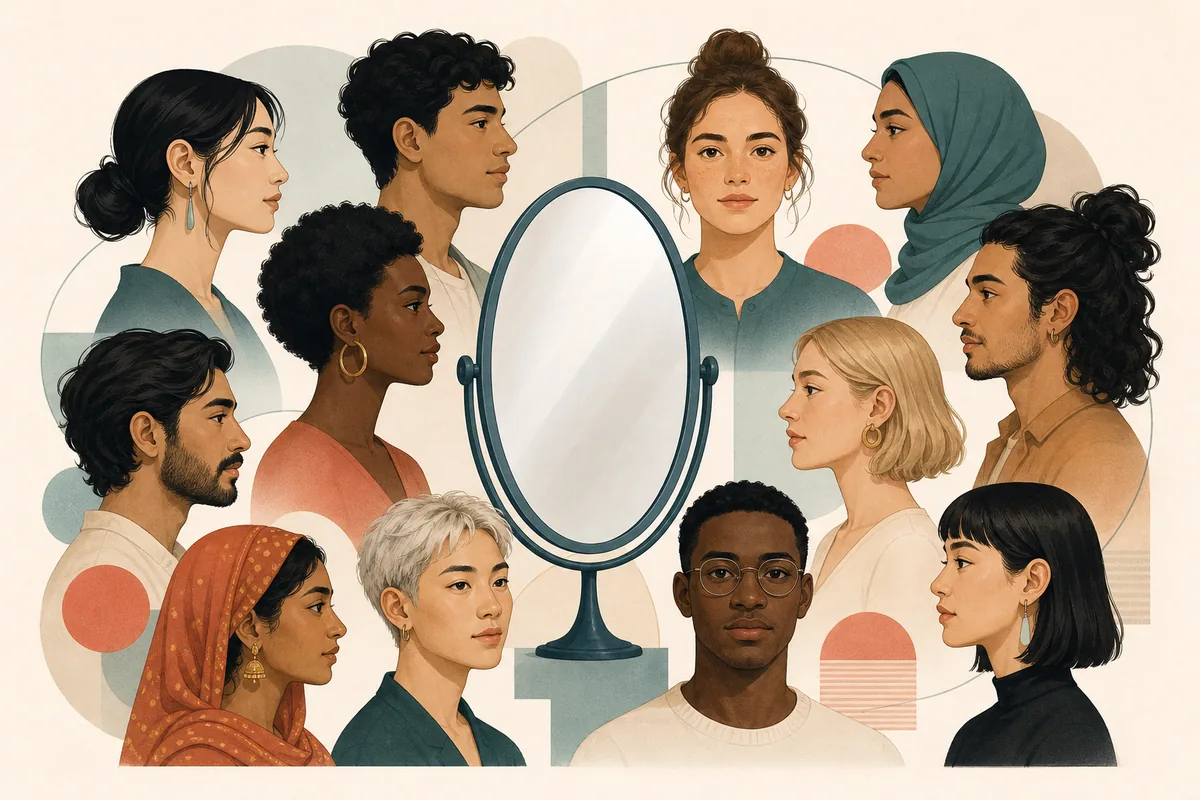
“Conventionally attractive” describes a pattern in how a group or culture tends to respond to certain features at a given time. It is not a medical finding, a character judgment, or a permanent verdict about one person. This guide separates social patterns from personal preference and explains how to use photo or AI feedback without treating it as an objective measurement.
Short answer
If you are asking “am I conventionally attractive?”, the most honest answer is that no single photo, facial ratio, or AI score can settle it. Conventional attractiveness usually means that some of your visible features fit beauty cues that are currently familiar or widely rewarded in a particular social setting. It does not mean everyone will prefer the same face, and it does not measure your worth.
A better approach is to separate three questions: how your features are read in a specific photo, how your styling and expression affect first impressions, and what you personally like. If you use an attractiveness test, treat it as one limited source of photo feedback. Look for repeated patterns across neutral images, keep the method consistent, and stop when measurement starts replacing ordinary life.
What does “conventionally attractive” mean?
The phrase refers to a broad social pattern: features that many people in a particular place, time, or media environment tend to describe as attractive. It is a description of a group response, not a rule written into the face. The pattern can include skin clarity, facial balance, expression, grooming, perceived health, and cues associated with a familiar beauty ideal, but the exact mix changes across communities.
“Conventional” is important because it distinguishes a common standard from an individual preference. Someone may look distinctive, memorable, stylish, or attractive to a particular person without fitting a mainstream template. The reverse is also true: a face can match a familiar ideal while still not appealing to every observer. The label is therefore contextual and probabilistic, not a pass-or-fail identity.
Keep these meanings separate
- Social pattern: A tendency in how a group responds to visible cues.
- Personal preference: What one observer finds appealing, familiar, or distinctive.
- Self-worth: A person’s value, character, relationships, and abilities, which a beauty label cannot measure.
Which cues can shape a first impression?
Research and everyday observation often point to combinations rather than one magic feature. In a controlled image, people may respond to apparent symmetry, averageness, skin and hair cues, feature spacing, facial expression, and the overall configuration of the face. These cues interact: a hairstyle can change the perceived outline, a smile can change the apparent balance of the lower face, and lighting can make skin look clearer or more textured.
It is better to treat these as possible influences than as a checklist. A perfectly symmetrical face is not required, and there is no reliable universal measurement that tells you whether a face is attractive. The same feature can read differently depending on expression, styling, age, cultural familiarity, and the observer’s own experience.
Possible cues, not a beauty formula
- Balance: How features appear to relate across the whole face, not whether each part is identical.
- Expression: Eye openness, a relaxed mouth, and a genuine smile can change the emotional read of a photo.
- Presentation: Camera distance, light, hair, glasses, makeup, facial hair, and clothing frame the face.
- Familiarity: People often respond more positively to faces or styles that feel familiar in their environment.
Why culture, media, and context matter
Beauty standards are not produced by facial structure alone. Media, fashion, local social groups, age, gender expectations, class signals, and repeated exposure can all influence which looks feel typical or desirable. A face photographed for a passport, a dating profile, a professional headshot, and a casual conversation is being interpreted in different contexts. The same person may appear more approachable, polished, dramatic, or youthful depending on the image choices around them.
This is why a search result, a comment section, or a social-media trend should not be treated as a universal verdict. Online spaces amplify certain looks and can make a narrow standard feel more objective than it is. If you are comparing yourself with a filtered or heavily selected image set, you are comparing your ordinary variability with someone else’s most optimized presentation.
Context questions to ask
- Where is the photo used?: Dating, work, social media, and everyday life reward different signals.
- What has been selected?: Crops, retouching, poses, and lighting can remove ordinary variation.
- Who is observing?: A person’s culture, experience, and preference affect the response.
Why one photo or AI score cannot answer the question
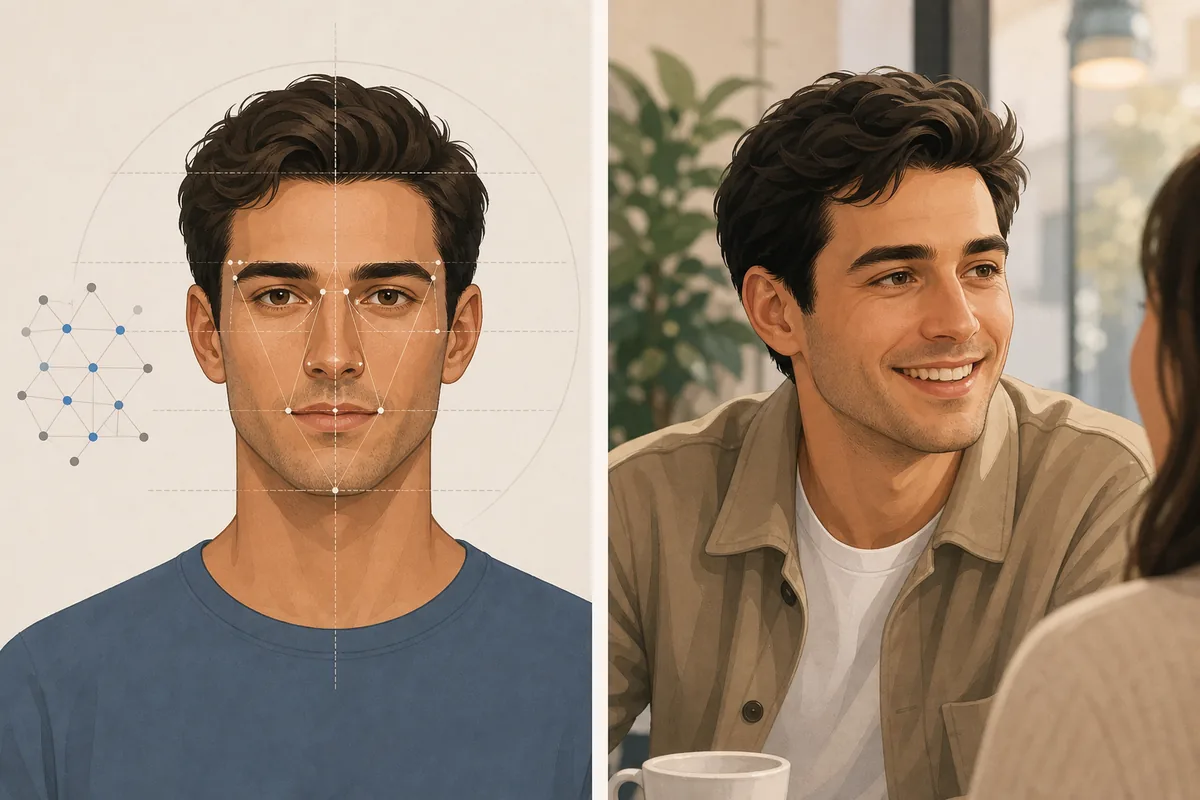
A photograph is a two-dimensional sample of a three-dimensional face. Lens distance changes perspective; head angle changes visible spacing; light changes skin contrast; and expression changes the apparent shape of the eyes, cheeks, mouth, and jaw. A close wide-angle selfie can make central features look larger than they would in a portrait taken farther away. That is a camera effect, not a sudden change in your face.
AI systems add another layer of uncertainty. A model may detect landmarks, compare patterns in its training data, and return a number, but the number depends on the model, the examples it learned from, the definition of attractiveness used, and the image quality. Two tools can disagree without either one discovering a hidden truth. The result is best understood as a narrow prediction about one image, not a measurement of conventional attractiveness in real life.
Common reasons results change
- Perspective: Camera distance and lens choice change the relative size of central and outer features.
- Pose: Rotation, chin angle, and eye direction move landmarks and alter the visible outline.
- Image selection: A model may react to background, crop, shadows, blur, or expression as well as the face.
- Model definition: Different systems use different data, labels, scales, and assumptions.
A calmer way to assess a photo
If your practical goal is choosing a profile photo, you do not need to prove that you are conventionally attractive. You need to learn which image communicates you clearly and suits the setting. Use a small, consistent set: one relaxed front-facing image, one natural three-quarter image, and one photo that reflects the environment where it will be used. Keep the camera at a normal distance, use even light, and avoid comparing a filtered image with an unedited one.
Then assess concrete outcomes instead of chasing a grade. Is your face easy to see? Does the expression feel like you? Does the crop leave enough space? Does the photo fit the audience and purpose? If you want outside feedback, ask a trusted person a specific question such as “Which image looks most natural?” Specific questions create more useful information than asking someone to rank your face.
A repeatable three-photo check
- Standardize: Use similar distance, lighting, crop, and expression before comparing images.
- Describe: Write down visible differences without turning them into a moral or personal judgment.
- Choose: Pick the image that serves the real purpose, such as clarity, warmth, or professionalism.
- Stop: Once the decision is good enough, return to the activity the photo supports.
Conventional, personal, and situational appeal are different
A useful way to reduce confusion is to name the type of appeal you are discussing. Conventional appeal asks whether a look resembles a currently familiar mainstream ideal. Personal appeal asks whether a particular observer likes the face, style, or energy. Situational appeal asks whether the presentation works for a particular goal, such as a professional introduction, a dating profile, a stage performance, or a candid photo.
These categories can overlap, but they do not have to. Someone can be distinctive rather than conventional, highly attractive to a particular person, or especially effective in a certain context. A single label cannot summarize all three. When you ask “am I conventionally attractive?”, adding the context makes the question more answerable and less likely to become a vague judgment about your whole identity.
Use the question that matches your goal
- Mainstream pattern: Does this presentation resemble a familiar beauty standard in this setting?
- Personal connection: Does the observer respond positively to this face, style, or expression?
- Practical result: Does the image communicate the impression you want for this specific use?
How to use attractiveness tools responsibly
An AI attractiveness test can be useful as a playful way to compare photo conditions or notice presentation variables. Before uploading an image, check what the service stores, whether it uses images for training, how long files are retained, and whether deletion is available. Do not upload another person’s photo without permission. If the result is upsetting, treat that reaction as a reason to pause rather than as evidence that the score is true.
Avoid using a score to make decisions about health, relationships, hiring, surgery, or personal safety. Appearance tools are not clinical assessments and cannot forecast how real people will treat you. If repeated checking makes you avoid normal activities, compare yourself compulsively, or feel worse, step away from the test and speak with someone you trust. A tool should support a small decision, not become the decision-maker.
A responsible boundary
- Use for photos: Ask what an image communicates, not what your entire face is worth.
- Protect privacy: Read storage and deletion terms before uploading a recognizable face.
- Keep perspective: Treat scores as uncertain feedback and compare patterns, not rankings.
- Take a break: Stop if checking increases distress, avoidance, or repetitive comparison.
Three ways people use the word “attractive”
Clarifying the type of question prevents a social pattern from being mistaken for a universal score.
| Question type | What it can describe | What it cannot prove |
|---|---|---|
| Conventional | Similarity to a familiar mainstream beauty pattern in a given culture or setting | That everyone will prefer the same look |
| Personal | One observer’s response to a face, style, expression, or overall presence | A universal ranking or stable social outcome |
| Situational | How well a specific photo communicates warmth, confidence, clarity, or professionalism | That the photo represents every version of the person |
| AI score | A model’s prediction about one submitted image under its own assumptions | Objective attractiveness, character, health, or future relationships |
Am I conventionally attractive? FAQ
Use a photo test as feedback—not a verdict
If you want to experiment with an image, start with consistent photo conditions and keep the result in context. For the measurement side of facial appearance, see the facial harmony and facial thirds guides; for a practical image check, use the free attractiveness test.
Research context
- Facial-attractiveness research commonly discusses combinations such as symmetry, averageness, sexual dimorphism, and skin cues rather than one universal feature.
- Rhodes (2006): a review of research on facial attractiveness, including the role of averageness, symmetry, and feature configuration.
- Clinical and social research describes group patterns under specific methods; it does not establish a permanent score for an individual person.