Facial Thirds Guide: Meaning, Ratio, and How to Measure Your Face
A practical, photo-friendly guide to upper, middle, and lower facial thirds, proportion balance, and what AI attractiveness tools can and cannot infer from one image.
Written By
Clara Vale
Beauty technology writer focused on making AI face analysis, facial proportions, and photo feedback easier to understand without turning appearance into a harsh formula.
Editorial Note
Published on June 28, 2026. This guide was selected after GSC review and Similarweb keyword generator validation across phrase match, related keywords, and question keywords for facial thirds, facial proportions, and face-analysis topics.
The short answer
Facial thirds are a simple way to describe vertical face balance. The face is usually divided into an upper third from the hairline to the brow area, a middle third from the brow area to the base of the nose, and a lower third from the base of the nose to the bottom of the chin.
The classic ideal is often described as a 1:1:1 relationship, but real faces vary by age, sex, ethnicity, hairstyle, camera angle, and expression. Use facial thirds as a guide for reading proportion and photo presentation, not as a strict beauty verdict.
What are facial thirds?
Facial thirds are one of the simplest frameworks for describing face proportions. Instead of judging one feature in isolation, the framework looks at whether the upper, middle, and lower parts of the face feel balanced when seen together. It gives people a vocabulary for why a face may look compact, elongated, top-heavy, midface-dominant, or lower-face dominant.
In the most common version, the upper third runs from the hairline area to the glabella, the smooth region between the brows. The middle third runs from the glabella to the subnasale, the point under the nose where the nasal base meets the upper lip. The lower third runs from the subnasale to the menton, the lowest point of the chin.
This matters for attractiveness discussions because proportion changes how features relate to each other. A strong jaw, a longer midface, a high forehead, or a shorter lower face may all look balanced or unbalanced depending on the rest of the face. The thirds do not tell the whole story, but they are a useful starting map.
The three facial thirds
- Upper third: Hairline or trichion to glabella; affected by forehead height, hairline, and brow placement.
- Middle third: Glabella to subnasale; affected by nose length, midface height, cheek structure, and camera angle.
- Lower third: Subnasale to menton; affected by lip height, chin length, jaw structure, and expression.
- Lower-third subdivision: Many guides also compare the upper lip area with the lower lip and chin inside the lower third.
- Photo readability: A front-facing, evenly lit photo makes the thirds easier to judge than a tilted or close selfie.
How to measure facial thirds from a photo
Start with a straight-on photo where the head is not tilted, the camera is not too close, and the face is evenly lit. Mark four horizontal landmarks: hairline, glabella, subnasale, and menton. Then compare the vertical distance from hairline to glabella, glabella to subnasale, and subnasale to menton.
If you are using a phone photo, do not overread tiny differences. Hair volume can hide the real hairline, smiling can shorten or lengthen the lower third visually, and a wide-angle selfie can stretch the center of the face. The goal is to notice obvious patterns, not to create a clinical measurement.
A practical approach is to measure the same person in two or three good photos. If the pattern stays similar, it may reflect real facial proportion. If it changes dramatically, the photo conditions are probably doing more work than the face itself.
For a clinical description of the upper, middle, and lower face divisions, this open-access review of facial dimension canons summarizes the common trichion, glabella, subnasale, and menton landmarks. For a research example showing why classical canons do not perfectly fit every population, this PMC study on neoclassical facial canons.
| Landmark | Where it is | Why it matters |
|---|---|---|
| Hairline / trichion | Visible midpoint of the hairline | Starts the upper third, but can be hard to judge with bangs or recession. |
| Glabella | Smooth area between the eyebrows | Separates upper and middle thirds. |
| Subnasale | Base of the nose where it meets the upper lip | Separates middle and lower thirds. |
| Menton | Lowest point of the chin | Ends the lower third and completes the vertical comparison. |
Facial thirds ratio: what does balanced mean?
The phrase facial thirds ratio usually points to the classic 1:1:1 idea: upper, middle, and lower thirds should be roughly equal. That ideal is easy to remember, which is why it appears in art, aesthetics, cosmetic consultation, and online face-analysis discussions.
But balanced does not always mean mathematically identical. A slightly longer lower third may look strong and attractive on one face. A slightly shorter lower third may look soft and youthful on another. A higher forehead may look elegant when the brows, eyes, and jaw still feel connected. The key question is whether the thirds support the whole face.
Use the ratio as a language for comparison. If one portrait looks better than another, ask whether the camera made the midface look longer, the chin look shorter, or the forehead look larger. That kind of observation is more useful than chasing a perfect number.
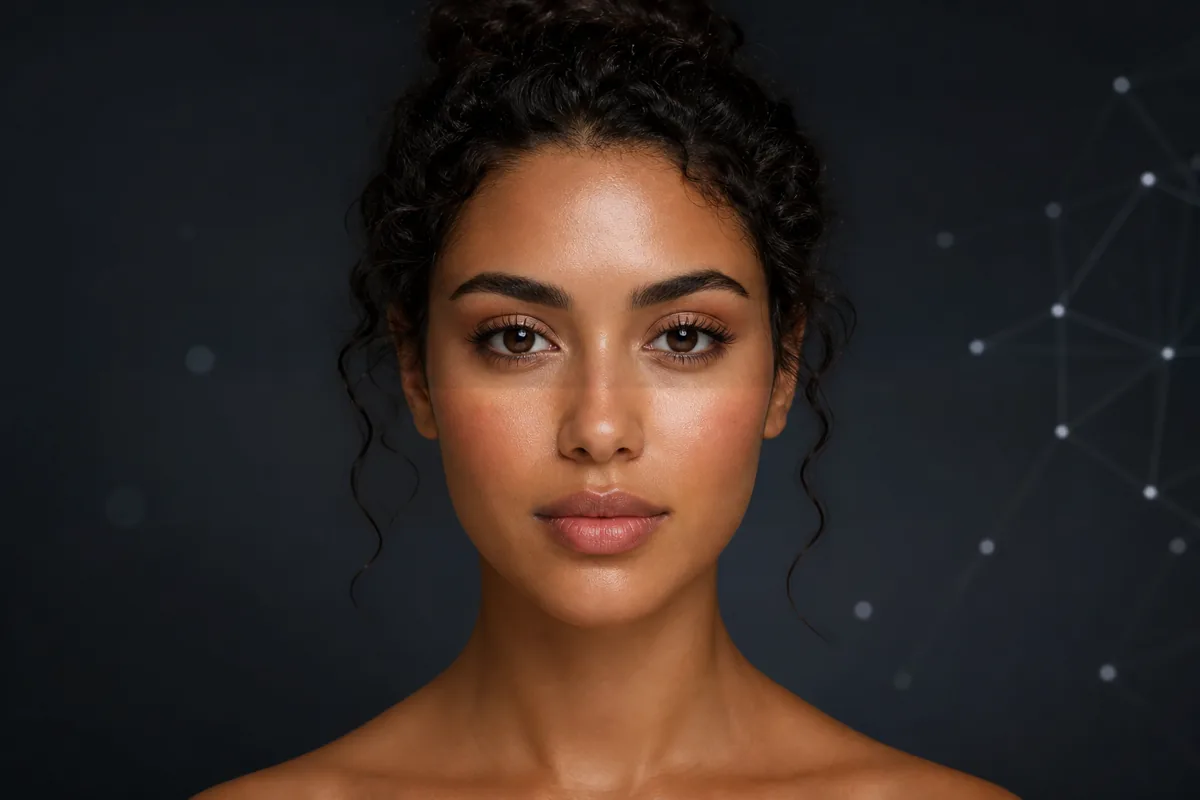
| Variable | Possible effect | Better practice |
|---|---|---|
| Close selfie lens | Can stretch the nose and midface | Step back and crop later. |
| Head tilt | Can shorten one section and lengthen another | Keep the face level for measurement. |
| Smile intensity | Can change the lower third visually | Use a neutral photo first, then compare a smile. |
| Hairline visibility | Can make the upper third hard to estimate | Use a photo where the forehead edge is reasonably clear. |
What unbalanced facial thirds can change
Unbalanced facial thirds can change the first impression of a face in a photo. A longer upper third may draw attention to the forehead or hairline. A longer middle third can make the face seem more elongated. A longer lower third can make the jaw and chin feel more dominant. None of these traits is automatically bad; they simply shift the visual emphasis.
This is where people often make the mistake of turning proportion language into flaw language. Distinctive thirds can be part of a memorable face. They only become a practical issue when a photo exaggerates them or when a styling choice makes the face look less coherent than it does in real life.
For photo feedback, the best question is not whether your thirds are perfect. Ask which part of the face dominates the image and whether a different camera distance, angle, expression, or crop would show the face more accurately.
| Pattern | Typical read | Better question |
|---|---|---|
| Roughly equal thirds | Often reads balanced in a front-facing photo | Does the full face still feel expressive and natural? |
| Longer upper third | Forehead or hairline may draw attention | Is the crop or hairstyle exaggerating it? |
| Longer middle third | Face may read more elongated | Is a close lens stretching the center of the image? |
| Longer lower third | Jaw and chin may feel more dominant | Does light, posture, or expression make it look stronger than usual? |
How AI face analysis reads facial thirds
AI attractiveness tools usually do not need the exact same labels a human guide uses. A model can detect facial landmarks, estimate distances, compare vertical proportions, and combine those signals with symmetry, skin visibility, lighting, and image quality. Facial thirds are one human-readable way to explain part of that process.
This means AI can be helpful for comparing photos, especially when one image clearly presents the face better than another. It cannot decide whether a person is attractive in every real-life context. It sees pixels, landmarks, and patterns from one submitted image.
If your score changes after switching photos, the thirds may not be changing at all. More often, the camera angle, head tilt, lens distance, or expression changes how those proportions appear to the model.
Signals an AI tool may read
- Landmark distances: Vertical spacing between brow, nose base, lips, chin, and visible hairline.
- Symmetry and alignment: Whether the face is centered enough for proportional readings to be stable.
- Lighting and contrast: Whether shadows make one third appear larger or smaller.
- Lens distortion: Whether a close selfie enlarges the center of the face.
- Expression: Whether smiling, tension, or mouth position changes the lower-third reading.
A practical facial-thirds workflow
Use facial thirds as a calm review tool. Choose one clear front-facing portrait, then one natural flattering portrait. Compare the upper, middle, and lower face in both. If one image looks more balanced, look for the reason: camera distance, head tilt, light, mouth posture, hairline visibility, or crop.
Then connect the observation to action. A longer-looking midface may simply need a less close lens. A dominant lower third may photograph better with softer light and a relaxed expression. A forehead that feels large in one crop may look balanced when the image includes the full hairline and jaw.
The point is not to redesign your face around a rule. The point is to understand why photos change visual balance, then choose images that represent you more fairly.
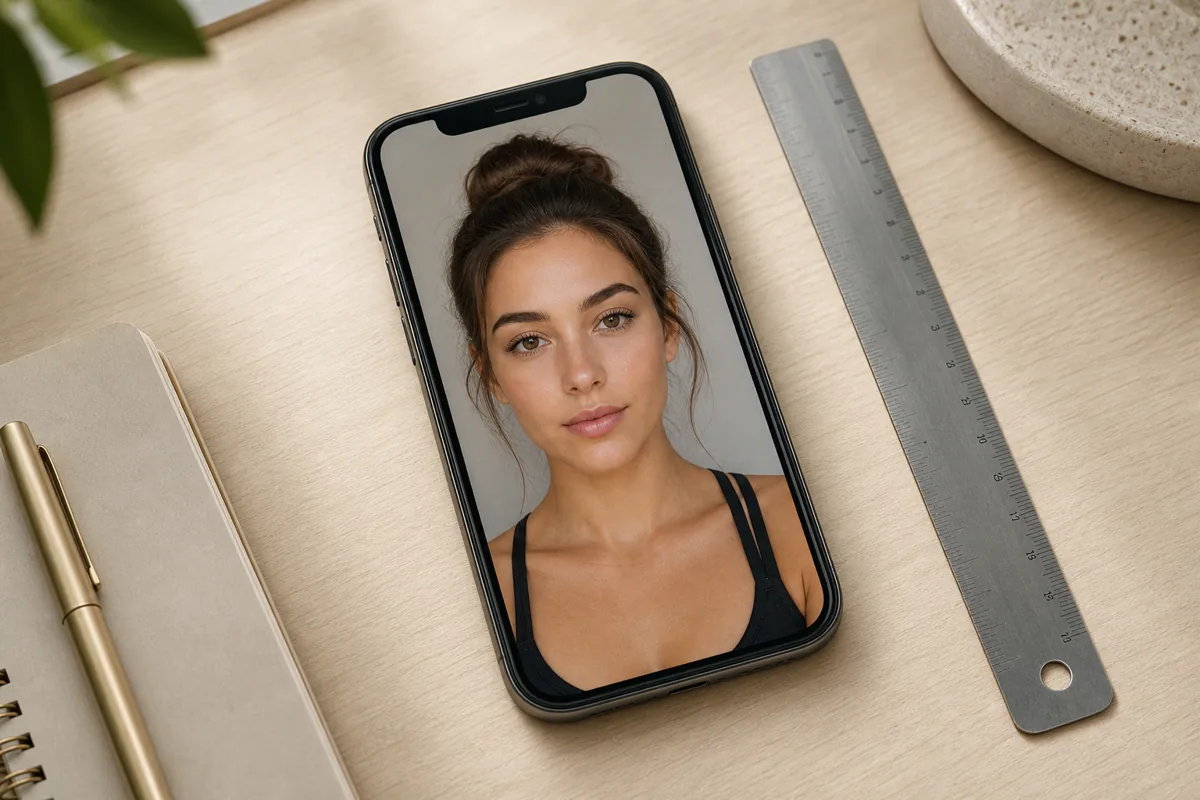
Step-by-step review
- Use a clean image: Face forward, even light, no extreme lens distortion.
- Mark the landmarks: Hairline, glabella, subnasale, and chin bottom.
- Compare broad distances: Look for obvious proportion patterns, not millimeter-level differences.
- Retest with another photo: Separate real proportion from camera distortion.
- Use the result gently: Treat the insight as photo feedback, not a personal verdict.
FAQ
Try proportion-aware AI face feedback
Once you understand facial thirds, an AI attractiveness test becomes easier to interpret. Use it to compare clean photos and notice how proportion, angle, and lighting affect the result.
For the healthiest reading, treat the score as photo feedback rather than a final judgment.
Sources and further reading
- Thappa DM. Canons of ideal facial dimensions and facial beauty. CosmoDerma 2023;3:90.
- Naini FB, Moss JP, Gill DS. The validity of selected neo-classical facial canons in young adults. Open-access study via PMC.
- Foo YZ, et al. Does 3-dimensional facial attractiveness relate to golden ratio, neoclassical canons, 'ideal' ratios and facial dimorphism? Open-access study via PMC.