PSL Score Guide: Meaning, Scale, Face Test, and Safer Use
A practical guide to PSL scores, PSL rating tests, online face scores, photo quality, and the limits of turning one image into a number.
Written By
Clara Vale
Beauty technology writer focused on making AI face analysis, photo feedback, and appearance-related search topics easier to understand.
Editorial Note
Published on 2026-05-12. This guide was created from current search demand around PSL score, PSL rating test, and PSL face rating test queries, then edited to avoid overlap with the site's main attractiveness test and face rating AI pages.
The short answer
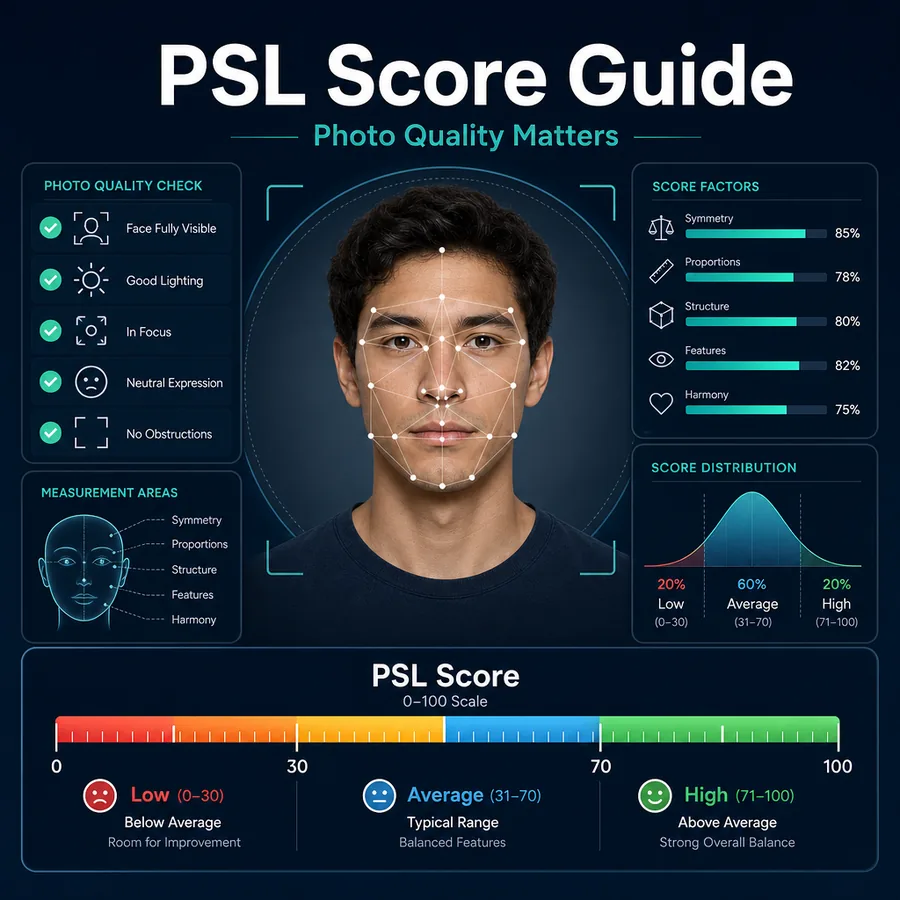
A PSL score is an informal face rating score used online to describe how conventionally attractive a face appears in a photo. In practice, a PSL rating test usually looks at visible traits such as facial symmetry, feature spacing, jawline definition, skin presentation, and photo quality.
The important part is that a PSL score is not a scientific identity label. It is best understood as a rough photo-based attractiveness estimate. It can help you compare portraits or understand why one image reads better than another, but it cannot measure your real-life charm, personality, confidence, voice, or how attractive someone may find you in person.
What is a PSL score?
PSL usually refers to an internet face rating framework that tries to rank facial attractiveness on a numeric scale. People search for PSL score, PSL rating test, and PSL face rating test when they want a more structured answer than a casual compliment or a vague beauty score. The appeal is obvious: a number feels direct, fast, and easy to compare.
The problem is that the number can feel more precise than it really is. A PSL score is usually based on visible signals in a still image, not on a complete picture of how someone looks in everyday life. Camera distance, lighting, lens distortion, expression, grooming, and image sharpness can all change the result before any deeper facial structure is considered.
A useful PSL score guide should therefore separate three things: facial structure, photo presentation, and interpretation. Facial structure includes features such as spacing, symmetry, and proportions. Photo presentation includes lighting, angle, blur, crop, and expression. Interpretation is the part where users decide whether to treat the output as practical feedback or as a harsh personal judgment.
The healthiest interpretation is narrow: a PSL rating test estimates how one image fits a particular rating system. It does not define whether you are attractive, dateable, memorable, photogenic in every setting, or valuable as a person.
What a PSL rating test usually looks at
- Facial symmetry: How balanced the left and right sides of the face appear in the uploaded photo.
- Feature spacing: The relative distance between the eyes, nose, lips, cheekbones, chin, and jawline.
- Bone structure cues: Visible jaw, cheekbone, brow, and chin definition, which many rating communities discuss heavily.
- Skin and surface presentation: Clarity, lighting, shadows, texture, and contrast that affect the first visual impression.
- Photo conditions: Angle, lens distance, resolution, crop, expression, and filters that can move the score.
PSL score vs attractiveness test vs face rating
These terms overlap, but they are not identical. An attractiveness test is the broadest phrase. It usually means a tool that estimates overall facial attractiveness from a photo and may include a beauty score, facial analysis, age estimate, or profile photo tips. That is the intent served by the main Attractiveness Test homepage.
A face rating test is narrower. It usually focuses on giving a simple face score or face rating, often from an AI system. That intent is already covered by the Face Rating AI page, which is why adding another generic face rating tool page would create keyword conflict.
A PSL rating test is more specific. Searchers using PSL language often want a scale explanation, a more blunt score framework, and a breakdown of what affects the rating. That makes it a good topic for an information page rather than another upload-first tool page.
The best site architecture is to let the PSL article answer the educational query, then link readers to the existing test when they are ready to upload a photo. That keeps each page's job clear.
For background on why facial ratings often discuss symmetry, averageness, and sexually dimorphic cues, this Annual Reviews overview of facial beauty is a useful starting point. For a broader non-technical overview, Wikipedia's physical attractiveness article.
| Term | Best search intent | Best page type |
|---|---|---|
| Attractiveness test | Users want to upload a photo and get a broad beauty or attractiveness score. | Main tool page with upload flow, result examples, and concise explanation. |
| Face rating AI | Users want a direct AI face score or face rating from a picture. | Dedicated face rating tool page with examples and photo tips. |
| PSL score | Users want to understand an internet rating scale and what the number means. | Educational guide with scale explanation, limits, and internal links to testing tools. |
| Beauty score test | Users want a softer beauty-oriented score, often for photos or selfies. | Could be covered inside the main tool rather than split into a competing page. |
How a PSL rating test usually works
A PSL rating test starts with the image. If the face is not visible, centered, and clear, the result becomes less meaningful. A front-facing portrait gives the system or reviewer a cleaner look at facial balance, feature placement, and overall harmony. A tilted selfie with strong shadows can make the same person look structurally different.
The next layer is feature reading. Many PSL discussions focus on jawline, midface, eye area, cheekbones, nose balance, facial width, and harmony between features. AI tools may not use community slang, but they often inspect similar visual zones through landmarks, proportions, and pattern recognition.
Then comes scoring. Some systems use a 1-10 style beauty score, while some PSL communities talk in narrower ranges. Either way, the score is a translation of visual impressions into a simplified number. That translation loses context. It cannot know how you look in motion, how expressive you are, or whether your features are more compelling in real life than in a frozen selfie.
That is why the most useful output is not just a number. A good PSL score online should help you understand what likely raised or lowered the result: lighting, camera distortion, expression, clarity, symmetry visibility, or feature balance.
| Rating area | What it may affect | Practical note |
|---|---|---|
| Eye area | Can affect perceived harmony, alertness, and facial balance. | Use lighting that keeps the eyes clear without harsh shadows. |
| Jaw and chin | Often influences perceived structure and lower-face definition. | Avoid close camera angles that distort the lower face. |
| Midface and nose balance | Can influence proportion readings across the center of the face. | Use a natural camera distance to reduce lens distortion. |
| Skin presentation | Can affect perceived polish before structure is even considered. | Use clean light and avoid over-sharpening or heavy smoothing. |
| Overall harmony | Describes how features work together rather than one isolated trait. | Compare photos where expression and framing are consistent. |
How to read the PSL scale without overreacting
The PSL scale is often discussed as if every decimal point is meaningful. In real use, that level of precision is rarely justified. Human appearance judgments vary by culture, preference, age, context, and mood. AI systems also vary by training data, image handling, and scoring method.
A more useful way to read the PSL scale is by broad bands. Lower results often mean the photo or the scoring model is not favorable. Middle results may suggest an average or mixed reading under that system. Higher results usually mean the image strongly matches the visual patterns the rater or model rewards.
If you receive a lower result than expected, the first step is not panic. Check whether the image was dark, close-lens distorted, heavily filtered, blurry, angled, or expressionless. Many people get a better and more realistic read from a clean front-facing photo and one well-lit soft-smile photo.
If you receive a high result, keep the same perspective. It means the submitted image performed well under the rating method. It can be useful for choosing profile photos, but it is still not a universal promise that every person or every tool will rate the image the same way.
| Result band | What it may mean | Better next step |
|---|---|---|
| Lower than expected | The image may be weak, distorted, or poorly matched to the scoring method. | Retest with clearer light, a natural lens distance, and a front-facing pose. |
| Middle range | The image reads as mixed or average under that particular framework. | Compare a soft-smile photo and a neutral photo to find what improves presentation. |
| Higher range | The photo likely matches many of the visual cues the rater or model rewards. | Repeat the same lighting, angle, and crop in future profile images. |
| Unstable across photos | Photo conditions are probably driving a large part of the score. | Look for patterns across three clean images instead of trusting one output. |
PSL score online: a safer workflow
Searchers often type PSL score online because they want an instant number. A safer workflow is to treat the number as the last step, not the first. Begin by checking whether the photo is suitable: one face, even light, natural lens distance, no heavy filter, and enough resolution to read the eye area and jawline.
Next, separate structural feedback from photo feedback. A note about jaw visibility may be about bone structure, beard shape, camera height, or shadow. A note about symmetry may be about head tilt, not permanent asymmetry.
Finally, compare only similar images. A bathroom mirror selfie, a studio headshot, and a wide-angle car selfie are not fair comparisons. Use two or three realistic portraits with small changes, then keep the one that communicates your features most clearly.
PSL score online checklist
- Photo first: Fix light, crop, distance, and focus before interpreting the number.
- Context second: Ask whether feedback describes facial structure or just the uploaded image.
- Pattern third: Trust repeat patterns across good photos more than one extreme result.
- Stop early: Use the score to pick better images, not to create a self-rating loop.
PSL score and looksmaxxing: where the boundary should be
PSL score looksmaxxing searches often mix practical grooming advice with emotionally risky score-chasing. A useful version improves photo quality, haircut, beard lines, skincare basics, posture, and expression so pictures represent you clearly.
If feedback becomes obsessive, insulting, or pushes extreme changes, step away from the score and focus on real-world wellbeing, healthier presentation habits, and trusted human feedback.
Why photo quality can change your PSL score
Photo quality is not a small detail in PSL testing. It is often the reason two photos of the same person receive different scores. A phone camera held too close can enlarge the nose, shrink the ears, and soften the jaw. Harsh overhead lighting can create tired-looking shadows. A low-resolution image can hide the details a rater needs to evaluate structure accurately.
A PSL face rating test also depends on symmetry visibility. If your head is turned, one side of the face becomes less readable. If your hair covers part of the jaw or eye area, the system may fill in gaps poorly. If your face is cropped too tightly, forehead, chin, and jaw proportions become harder to judge.
The practical solution is to treat the first result as a draft. Upload a clean neutral portrait, then compare it with a second image that has better lighting or a softer expression. If the score moves a lot, the test is telling you as much about photo conditions as about facial structure.
This is not a weakness unique to PSL tools. It is a basic limitation of any image-based attractiveness score.
Photo checks before trusting the score
- Use even light: Soft front light usually gives a cleaner facial read than overhead or side light.
- Avoid close-lens distortion: Step back slightly and crop later so the camera does not stretch facial proportions.
- Keep the face visible: Show eyes, nose, lips, jawline, chin, and forehead without heavy obstruction.
- Compare more than one image: A stable pattern across several good photos is more meaningful than one random result.
- Skip aggressive filters: Retouching and strong contrast can make the output less realistic.
How to use a PSL score online in a useful way
The best use of a PSL score online is not self-judgment. It is photo feedback. If one portrait scores better than another, ask what changed. Was the lighting softer? Was the angle more natural? Was the expression more open? Did the crop show the jaw and eye area more clearly?
This approach turns a rating into a practical tool. You can use it to choose a dating profile photo, compare professional headshots, test whether filters help or hurt, or understand why one selfie looks stronger than another. That is a reasonable use case because the action stays focused on images.
Avoid using a PSL rating test as a permanent rank. Online rating communities can be blunt, culturally narrow, and sometimes emotionally harsh. A numeric score does not capture kindness, charisma, body language, style, confidence, humor, or chemistry. It also cannot predict who will find you attractive in a real relationship or social setting.
A balanced workflow is simple: test a clear photo, read the result as one signal, compare another photo, look for repeat patterns, and use the insight to improve presentation. Then stop before the number becomes a loop.

A better PSL testing workflow
- Start with one neutral front-facing image: This creates a baseline for symmetry and feature spacing.
- Add one flattering but realistic portrait: A soft smile and good light can show how presentation affects the score.
- Write down what changed: Track angle, light, expression, crop, and distance instead of only the number.
- Use the result for image selection: Choose photos that communicate your features clearly and confidently.
- Do not chase decimals: Broad patterns are more reliable than tiny score differences.
Frequently asked questions
Want to test a photo after reading the PSL score guide?
Use a clear, front-facing image first, then compare it with another good portrait. The pattern across photos will usually teach you more than one isolated PSL score.
If you want a broader AI face analysis instead of a PSL-only interpretation, start with the free attractiveness test or the dedicated Face Rating AI page.
Background sources and editorial grounding
- Search intent was selected from existing Google Search performance where PSL score, PSL rating test, PSL face rating test, PSL scale test, and PSL score online appeared without a dedicated landing page.
- The page intentionally avoids competing with the homepage's attractiveness test keyword and the Face Rating AI page's face rating keyword.
- Facial-attractiveness context was informed by research summaries discussing symmetry, averageness, feature proportions, and image-based perception.
- Editorial position: a PSL score is a limited photo-based signal and should not be used as a measure of personal worth, relationship potential, or complete real-world attractiveness.