Facial Harmony Explained: Meaning, Proportions, and What Makes a Face Look Balanced
A practical guide to facial harmony, facial thirds, feature balance, and how AI attractiveness tools talk about a harmonious face.
Written By
Clara Vale
Beauty technology writer focused on turning face-analysis jargon into practical advice readers can use when testing photos and understanding AI ratings.
Editorial Note
Published on 2026-06-05. This article was created from Similarweb and Semrush keyword validation around facial harmony, then structured to complement the site's existing attractiveness test, PSL score guide, and face rating pages without duplicating their intent.
The short answer
Facial harmony means that your features look balanced together. Instead of asking whether one nose, one pair of eyes, or one jawline is attractive on its own, facial harmony asks whether the full face feels proportionate, connected, and visually coherent when people look at it.
That is why people with individually ordinary features can still look striking, while someone with one standout feature may not always look more attractive overall. Harmony is about how the parts work together. AI face-rating tools often try to estimate that balance through proportions, symmetry cues, facial thirds, and image clarity, but they still judge a photo, not your entire real-life presence.
What facial harmony means in plain language
When people search for facial harmony, they are usually not asking for a single score. They are asking why some faces look balanced, pleasing, or visually "right" even when no single feature is extreme or dramatic. In beauty discussions, facial harmony describes the overall relationship among the eyes, nose, lips, jaw, forehead, cheekbones, and chin rather than one isolated trait.
That is an important distinction because face analysis online often becomes too feature-focused. A person may worry about one trait such as nose size, lip fullness, jaw sharpness, or eye spacing. But observers usually react to the whole composition first. A feature that looks strong in isolation can still fit beautifully inside the full face, while a feature often praised online may look less impressive if it feels out of rhythm with the rest of the structure.
In other words, facial harmony is not the same thing as perfection. It does not require identical left and right sides, mathematically exact ratios, or celebrity-level bone structure. It means the face feels internally balanced enough that the viewer's attention moves smoothly across it without one mismatch dominating the impression.
This is also why facial harmony is a more useful concept than many harsh internet rating systems. It gives people a framework for understanding proportion and presentation without forcing their face into one crude number.
What people usually mean when they say a face looks harmonious
- Balanced feature spacing: The eyes, nose, lips, and chin do not feel crowded, stretched, or disconnected from one another.
- Consistent visual flow: The upper, middle, and lower face feel connected rather than fighting for attention.
- Proportion that feels natural: The face may not be mathematically perfect, but the overall structure looks coherent and easy to read.
- No single mismatch dominating the impression: One feature can still be distinctive, but it does not make the rest of the face feel disconnected.
- Harmony plus presentation: Lighting, angle, grooming, and expression can either support or weaken how harmonious the face appears in a photo.
What usually creates a harmonious face
Most harmony discussions come back to the same cluster of ideas: proportions, symmetry, facial thirds, and how clearly the features relate to one another. That does not mean beauty is only geometry. It means geometry gives us one language for describing why a face feels balanced.
Symmetry matters, but it is only one piece. Nearly everyone has mild asymmetry, and many attractive faces are not perfectly symmetrical. What often matters more is whether the asymmetry is subtle enough that it does not interrupt the full-face impression. A small unevenness can even add character, while still preserving harmony overall.
Feature compatibility matters just as much. A stronger nose can look excellent with the right chin and brow structure. Fuller lips can feel balanced when the midface and chin support them. A softer jawline can still look harmonious if the eye area, cheek shape, and lower-face proportions work well together. This is why people sometimes say someone has "good facial harmony" even if no single feature would go viral in a close-up.
For practical readers, the main lesson is simple: do not judge your face one feature at a time. Ask how the features interact. That question is much closer to how real people and better AI systems read a face.
For a research-oriented background on why harmony is often discussed alongside symmetry, averageness, and sexual dimorphism, this Annual Reviews overview of facial beauty is a strong starting point. For general terminology around physical attractiveness and proportion-based beauty ideas, Wikipedia's physical attractiveness overview.
| Concept | What it usually means | Why it matters |
|---|---|---|
| Facial harmony | How well the full set of features works together as one composition. | It shifts the focus from one flaw-based feature to the overall face. |
| Symmetry | How balanced the left and right sides of the face appear. | Mild asymmetry is normal, but large visible imbalance can affect harmony. |
| Facial thirds | The relationship among the upper, middle, and lower face. | Big proportion shifts can make the face feel top-heavy or bottom-heavy. |
| Golden ratio | A famous mathematical proportion often used in beauty marketing. | It can describe some patterns, but it is not a universal beauty law. |
Facial thirds, proportions, and ratios without the hype
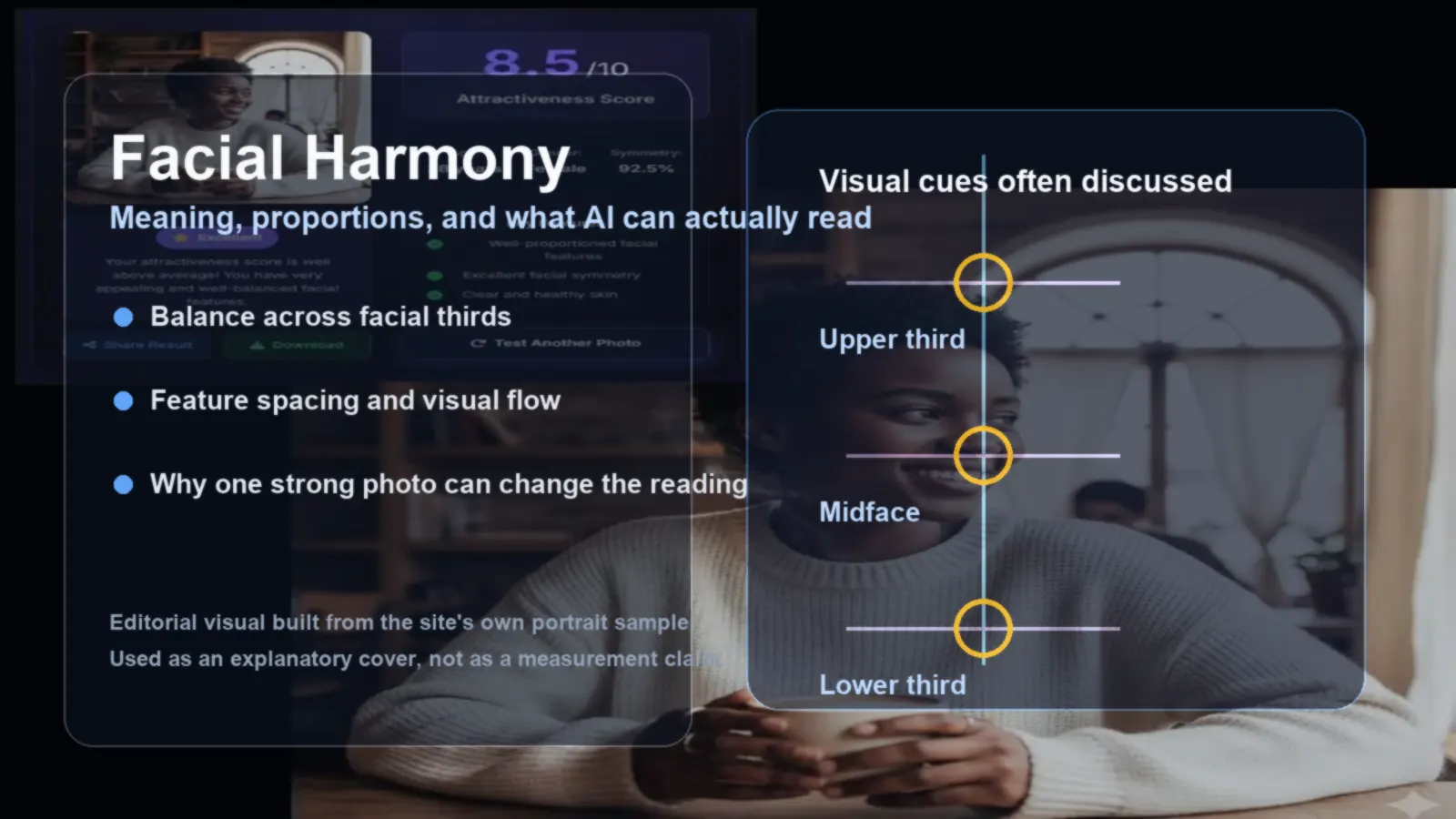
One of the most common ways people explain facial harmony is through facial thirds. This means dividing the face into an upper third, a middle third, and a lower third. The idea is not that every attractive face has perfectly equal thirds. The real point is that large imbalances can make the face feel top-heavy, midface-dominant, or lower-face dominant in a way that changes the visual flow.
Feature spacing also matters. Eye distance, nose length, philtrum length, lip projection, chin projection, and jaw width all shape whether the face feels compact, stretched, sharp, soft, or well integrated. AI tools often reduce these impressions into measurable landmarks and ratios because numbers are easier for software to compare than human-style descriptions.
The danger is taking these ratios too literally. The golden ratio is often mentioned in beauty conversations, but it is not a universal law of attractiveness. A face can feel balanced without matching a famous ratio exactly. Harmony is broader than one formula. It comes from how the visible parts support one another, not from chasing one mythic number.
That is why facial harmony works best as a descriptive tool, not a rigid pass-fail test. It can help you understand why one portrait feels stronger than another, but it should not be used as proof that beauty can be solved like a spreadsheet.
| Photo variable | Possible effect | Better practice |
|---|---|---|
| Camera distance | A very close lens can enlarge the center of the face and distort proportions. | Step back slightly and crop later. |
| Lighting direction | Harsh light can deepen shadows and exaggerate imbalance. | Use soft front light when possible. |
| Head tilt | Tilt can make symmetry and thirds harder to read. | Use one straight portrait as a baseline image. |
| Crop | A tight crop can hide forehead, chin, or jaw context. | Keep the full facial frame visible. |
How AI face-rating tools try to read facial harmony
AI attractiveness tools do not usually think in the same words people do, but they often measure related ideas. Instead of saying "this face has good harmony," a model may detect landmarks, calculate distances, estimate symmetry, compare visible ratios, and combine those signals with photo quality. The result is often a beauty score, face rating, or attractiveness estimate.
This means AI tools can be useful for comparing photos, but they are not final judges of harmony. If one image scores better than another, the model may be responding to improved lighting, more centered framing, or clearer visibility of the jaw and eye area rather than a deeper truth about your face.
Harmony can also be flattened by the medium itself. In real life, movement, expression, hairstyle, styling, voice, posture, and emotional presence all affect how balanced and attractive a person seems. A still image removes most of that. AI then compresses the remaining visual data even further into a rating output.
The best use case is to treat harmony-related scores as image feedback. They can show which portrait presents your facial structure more clearly. They cannot tell the whole story of why someone is appealing in person.
| Reading | What it often suggests | Better next step |
|---|---|---|
| Photo looks less balanced than expected | Presentation issues may be reducing how clearly your proportions read. | Would better light, less distortion, or a straighter angle change the impression? |
| Photo looks generally balanced | The image likely presents your features in a coherent, readable way. | What framing and lighting choices helped this image work? |
| Different photos give very different impressions | The camera setup may be changing the visual flow more than you thought. | Which image conditions consistently support the strongest result? |
| One feature still stands out strongly | The feature may be distinctive, but that does not automatically mean disharmony. | Does it truly disrupt the whole face, or is it simply characteristic? |
Limits, myths, and what facial harmony does not mean
The first myth is that facial harmony means every feature must be small, average, or invisible. That is false. Many memorable faces have strong noses, wider jaws, lower brows, higher cheekbones, deeper-set eyes, or sharper lower thirds. Harmony is not the absence of character. It is the successful integration of character.
The second myth is that one ratio, one surgery trend, or one viral filter can fix harmony for everyone. Real faces differ too much for that. A change that improves one face can easily unbalance another. Even in cosmetic contexts, people often talk about preserving harmony rather than copying a feature from someone else.
The third myth is that AI can fully diagnose harmony. AI can measure visible patterns in one image. It cannot understand charisma, chemistry, voice, or how your features animate in conversation. It also inherits bias from its training data and may reward a narrower beauty norm than real people do.
A healthier takeaway is that harmony is descriptive, contextual, and useful in moderation. It helps explain appearance patterns. It should not become a harsh identity label.
Healthy ways to think about facial harmony
- Think in relationships, not isolated flaws: Ask how features work together before assuming one trait ruins the whole face.
- Do not worship one ratio: Golden-ratio claims are catchy, but harmony is broader than one numeric formula.
- Remember photos exaggerate imbalance: Lens distance, head tilt, and light can make a balanced face look less harmonious in one image.
- Treat AI scores as partial signals: A model can estimate visible balance, but it cannot read your full real-life attractiveness.
- Use harmony to improve presentation: The most practical benefit is better photo choice, styling, and expectation-setting.
How to use facial harmony as useful feedback instead of self-punishment
Facial harmony becomes useful when you apply it to images, styling, and interpretation. For example, if one portrait feels stronger, ask whether the camera distance preserved your proportions better, whether your expression softened a strong lower face, or whether the light made the eyes and midface look more connected.
This is also where the concept can help with profile photos. A picture that shows your structure clearly, avoids distortion, and keeps the full face readable will usually communicate harmony better than a close, dark, overfiltered selfie. That is a practical insight you can use immediately.
If you want to compare images, start with one neutral front-facing portrait and one well-lit flattering portrait. Upload both to an AI tool, then compare the difference. Look for patterns in framing, light, crop, and expression. Those clues are often more valuable than the exact score.
The goal is not to chase a mythical perfect face. The goal is to understand how your face reads, how different photos change that reading, and how to present yourself more accurately and confidently.

A better facial harmony workflow
- Start with a clear front-facing portrait: Use even light and a natural camera distance so the face is easy to read.
- Compare two strong photos, not ten random ones: A small controlled comparison reveals more about harmony than a pile of inconsistent selfies.
- Notice what changed visually: Track angle, light, crop, and expression instead of obsessing over a tiny score shift.
- Use the insight for better image selection: Choose the portrait that presents your features most clearly and coherently.
- Keep the idea proportional: Harmony is one lens for reading a face, not a final verdict on attractiveness.
Frequently asked questions
Want to test your photos with facial harmony in mind?
Start with one clean front-facing portrait, then compare it with a second strong image. Look for repeat patterns in light, crop, and expression instead of chasing one perfect number.
If you want a broader image-based score after learning the harmony concepts, use the free attractiveness test or the dedicated face rating page.
Background sources and editorial grounding
- Primary topic choice was validated with Similarweb keyword ideas and Semrush fallback volume/KD checks, where facial harmony showed distinct informational intent and low competition.
- This page was scoped to avoid overlap with the homepage's attractiveness test keyword, the Face Rating AI page's tool intent, and the PSL score guide's community-rating intent.
- Research grounding included review literature on facial attractiveness, symmetry, averageness, and the way visible proportions affect perceived beauty.
- Editorial position: facial harmony is a useful descriptive concept for photos and face analysis, but it should not be treated as an absolute measure of personal worth.