Canthal Tilt: What Positive, Neutral, and Negative Eye Tilt Really Mean
A practical guide to reading eye tilt in face analysis without turning one angle into a full attractiveness verdict.
Written By
Clara Vale
Beauty technology writer focused on AI face analysis, profile-photo feedback, and evidence-aware appearance guides.
Editorial Note
Published on May 23, 2026. This guide was selected from GSC and Similarweb opportunity research because canthal tilt has strong search demand while the current site did not have a dedicated page for this distinct eye-area topic.
Quick answer
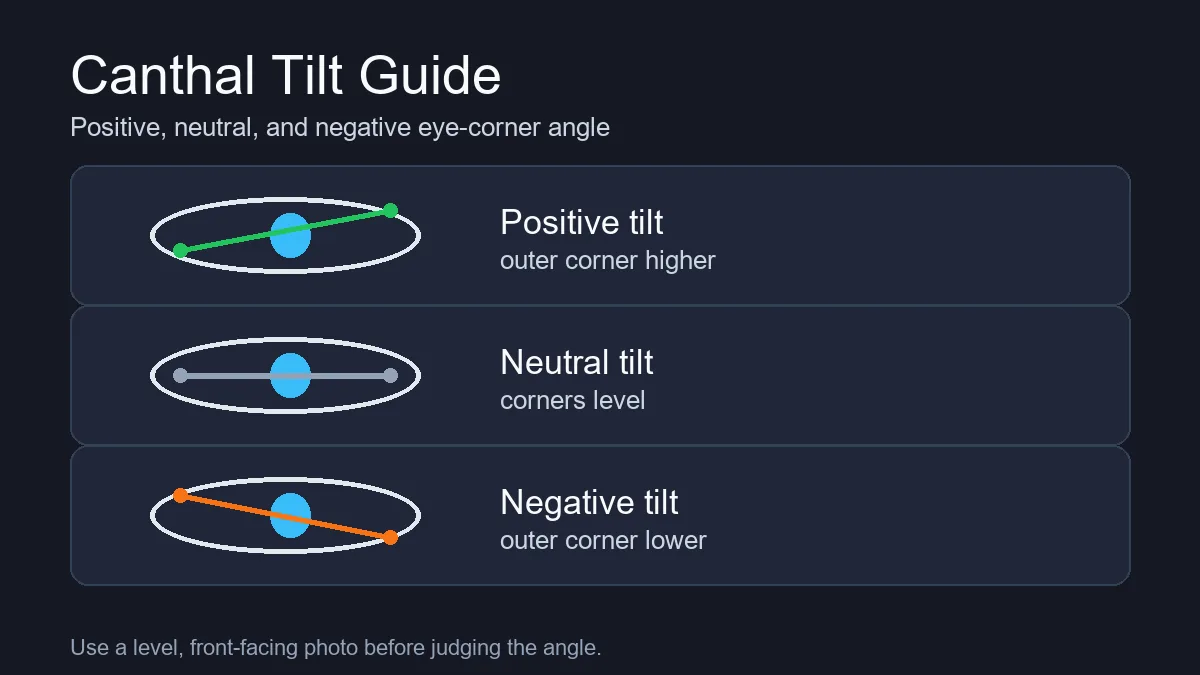
Canthal tilt is the angle between the inner corner of the eye and the outer corner of the eye when the face is viewed from the front. If the outer corner sits higher, the eye has a positive canthal tilt. If both corners are close to level, it is neutral. If the outer corner sits lower, it is negative.
The angle can influence how alert, lifted, soft, tired, or downturned the eye area appears in a still photo, but it is only one cue. Facial harmony, brow shape, eyelid exposure, orbit depth, lighting, head angle, and camera distortion can matter just as much when an AI attractiveness test or face rating tool reads an image.
What is canthal tilt?
Canthal tilt describes the slope of the eye corner line. In face-analysis language, the inner corner is the medial canthus and the outer corner is the lateral canthus. Draw a simple line from the inner corner to the outer corner: the direction of that line is the canthal tilt.
People search for canthal tilt because it is one of the easiest eye-area terms to notice in photos. A small upward or downward slope can change the expression of the face, especially in selfies where the camera is close and the eyes are a major focus. That does not mean the angle is destiny. It is a visible feature, not a complete beauty score.
A useful canthal tilt guide should keep the definition simple and the interpretation balanced. The measurement belongs inside a wider face analysis that includes eye shape, eyelid show, brow position, facial symmetry, midface support, jaw balance, skin presentation, and photo quality.
For AI photo feedback, the most important point is this: canthal tilt is read from pixels. Head tilt, lens distance, lighting, lashes, makeup, and expression can all make the same eye area look more positive, neutral, or negative than it does in person.
Terms to know before reading the angle
- Medial canthus: The inner corner of the eye, closest to the nose.
- Lateral canthus: The outer corner of the eye, closest to the temple.
- Tilt line: The visual line connecting the inner and outer eye corners.
- Eye-area context: Brow, eyelid exposure, orbit depth, lashes, and surrounding structure that change how the tilt is perceived.
- Photo condition: Camera height, head rotation, lens distance, shadows, and filters that can distort the apparent angle.
Positive, neutral, and negative canthal tilt
A positive canthal tilt means the outer corner of the eye sits higher than the inner corner. It often creates a lifted, almond-like, alert appearance in front-facing photos. A neutral canthal tilt means the two corners are roughly level. A negative canthal tilt means the outer corner sits lower, which can sometimes make the eye area appear softer, rounder, tired, or sad in a frozen image.
Search results often overstate this difference. Some pages treat positive canthal tilt as automatically attractive and negative canthal tilt as automatically bad. That is too narrow. A slight negative or neutral tilt can fit a face beautifully when the rest of the eye area and facial structure are harmonious. A strongly positive tilt can also look unusual if it clashes with the face.
The better question is not whether one label is good or bad. The better question is how the eye corner line interacts with the rest of the face. In a face rating context, canthal tilt is one input among many, not the whole score.
This is why the new page does not compete with the homepage attractiveness test. The homepage answers “upload a photo and get a score.” This guide answers “what does this specific eye-area term mean, and how should I interpret it?”
For anatomy and aesthetics context, the American Academy of Ophthalmology EyeWiki page on canthoplasty explains why canthal structures matter in eyelid procedures, while this Annual Reviews article on facial beauty research.
| Type | What it means | How to interpret it |
|---|---|---|
| Positive canthal tilt | The outer eye corner sits higher than the inner corner. | Often reads as lifted or alert, but still depends on eye shape and facial harmony. |
| Neutral canthal tilt | The inner and outer corners are roughly level. | Usually reads balanced and does not strongly help or hurt by itself. |
| Negative canthal tilt | The outer eye corner sits lower than the inner corner. | Can look soft, tired, or downturned in some photos, but is not automatically unattractive. |
| Apparent tilt | The angle created by camera, head position, makeup, lashes, or shadows. | This is why casual selfies can misrepresent the real eye corner line. |
How to check canthal tilt from a photo
Start with a clear, front-facing image. The eyes should be open naturally, the head should not be tilted, and the camera should be close to eye level. If one side of the face is closer to the lens, the apparent eye line can shift.
Then identify the inner and outer corners of each eye. Imagine a straight line connecting those two points. If the line rises toward the temple, the tilt is positive. If it is nearly horizontal, it is neutral. If it falls toward the temple, it is negative. Compare both eyes because many people have mild asymmetry.
Avoid reading too much into tiny differences. A one- or two-degree shift is hard to judge from casual selfies. Eyelashes, eyeliner, folds near the outer eyelid, and shadows can make the corner look higher or lower than it is.
If you want to compare photos, keep the conditions consistent: same camera height, similar distance, similar expression, and no heavy beauty filters. That makes the result more useful for photo feedback.
| Variable | Possible effect | Better practice |
|---|---|---|
| Head tilt | Makes one eye line look higher or lower than it really is. | Level the face before judging the angle. |
| Camera height | Looking up or down can exaggerate the slope. | Keep the lens close to eye level. |
| Lens distance | Close selfies can distort the eye and midface area. | Step back slightly and crop later. |
| Lashes and eyeliner | Outer-corner styling can mimic a stronger positive tilt. | Use a natural baseline photo for measurement. |
| Lighting and shadows | Shadows can hide the true canthus point. | Use even front light. |
How canthal tilt affects attractiveness ratings
Canthal tilt can influence perceived attractiveness because the eye area carries a lot of expression. A lifted outer corner can look awake or sharp. A downward outer corner can look gentle, tired, sad, or soft depending on the rest of the face. Neutral tilt usually reads as balanced and does not strongly push the score by itself.
In AI attractiveness tests, the angle may interact with landmark spacing, symmetry, eyelid exposure, brow height, and image quality. If a model rewards eye-area sharpness, a positive tilt may help. If a model is sensitive to face harmony, a neutral or slightly negative tilt may still score well when other features are strong.
The mistake is treating canthal tilt like a single master switch. A face with strong symmetry, clear skin presentation, flattering lighting, and balanced proportions can still photograph well with neutral or mildly negative tilt. A face with a positive tilt can still score poorly if the image is dark, distorted, tense, or heavily filtered.
Use canthal tilt as a diagnostic clue, not a verdict. It can explain why one portrait looks more lifted than another, but it cannot measure personality, style, charisma, movement, or real-life attraction.
| Observation | What it may mean | Best next step |
|---|---|---|
| Clearly positive in several level photos | The outer corners naturally sit higher. | Use it as one eye-area strength, not the whole score. |
| Mostly neutral | The eye corner line is balanced and likely not a major rating driver. | Focus on lighting, expression, and overall face harmony. |
| Mildly negative | A normal variation that may look soft or downturned depending on context. | Compare better-lit photos before drawing conclusions. |
| Changes between photos | The image conditions are probably influencing the reading. | Standardize camera height, head angle, and expression. |
Photo mistakes that make canthal tilt look wrong
The most common mistake is head tilt. If the whole head is rotated, one eye corner line can look more positive and the other can look more negative. Always level the face before judging the angle.
Camera height also matters. Looking up into the camera can make the eyes look more lifted, while looking down can exaggerate a downward slope. A very close phone lens can stretch the center of the face and change the way the outer corners appear.
Makeup and lashes can create a false signal. Winged liner, outer-corner shadow, heavy lashes, or a crease near the outer eyelid may visually lift the eye even when the actual canthus is neutral. Shadows can do the opposite.
For AI analysis, low resolution and blur are also a problem. If the model cannot locate the eye corners accurately, the angle becomes less trustworthy.
Before judging your canthal tilt
- Level the head: Use a front-facing image where the nose, chin, and brow line are not tilted.
- Keep camera height neutral: Place the camera close to eye level so the eye corner line is not distorted.
- Use even lighting: Avoid shadows that hide the outer corner or make the eyelid fold look like the canthus.
- Limit makeup effects: For measurement, compare an unedited image before relying on winged liner or heavy lashes.
- Check both eyes: Small asymmetries are normal, so look for the overall pattern rather than one corner.
How to use canthal tilt insight safely
The healthiest use of canthal tilt is photo selection. If one picture makes your eyes look more balanced, open, or lifted, compare the photo conditions that created that effect. You may learn that a slightly higher camera, softer light, or more relaxed expression works better for you.
If you are using an attractiveness test, treat the result as feedback on the submitted image. A lower score does not mean one feature ruined your face. It may mean the image made the eye area harder to read, exaggerated asymmetry, or combined with other photo issues.
Do not use internet labels like positive, neutral, or negative as identity labels. They are descriptive geometry terms. Real attractiveness is broader than one eye angle and depends on the full face, presentation, movement, and personal preference.
A good workflow is simple: take a neutral front-facing photo, run the free attractiveness test, compare it with a second strong portrait, and look for repeat patterns. If canthal tilt appears to affect the result, use that insight to choose better photos rather than to judge yourself.

A practical testing workflow
- Take one neutral baseline photo: Use even light, eye-level camera height, and a relaxed expression.
- Compare a flattering portrait: Try a soft smile and small angle change without changing everything at once.
- Note the eye-area difference: Look at tilt, eyelid exposure, brow position, and shadows together.
- Run the AI test for photo feedback: Use the score to compare images, not as a permanent judgment.
- Keep the broader context: Canthal tilt is one feature inside overall face harmony.
Frequently asked questions
Want to compare photos with better context?
Use a clear, eye-level portrait first, then compare it with a second strong photo. If the eye area looks different, check lighting, head angle, and expression before assuming the feature itself changed.
You can run the free attractiveness test for a broader AI photo reading, then use this guide to understand one eye-area cue inside that result.
Sources and editorial grounding
- Keyword selection used GSC data for attractiveness-test.org and Similarweb keyword expansion. Similarweb showed strong demand for canthal tilt with low directional difficulty compared with broader attractiveness-test terms.
- The page avoids the homepage query cluster around “attractiveness test” and the existing Face Rating AI page cluster around direct photo scoring.
- Anatomy context was checked against oculoplastic references describing medial/lateral canthal structures and canthal tilt relevance in eyelid procedures.
- Facial attractiveness context was grounded in broader research on symmetry, averageness, sexual dimorphism, and image-based perception.