Midface Ratio: How to Measure It and What It Really Means
A practical, evidence-aware guide to the internet beauty metric—without turning one photo ratio into a verdict on your face.

Editorial note
Midface ratio is not one universally standardized clinical measurement. Online communities, aesthetic clinics, artists, and anthropometric studies may use different landmarks and formulas. This guide separates those definitions before interpreting any number.
Quick answer: what is midface ratio?
Midface ratio is an informal way to describe the vertical length of the central face compared with another facial distance, usually face width or lower-face length. The central region generally spans the eyes, nose, cheeks, and upper lip, but the exact start and end points change between formulas.
That inconsistency matters. A ratio calculated from the pupil line to the mouth is not interchangeable with a clinical facial-third measurement from the brow area to the base of the nose. Use the number to compare standardized photos of the same person—not to rank people or diagnose facial development.
What the midface ratio actually describes
The midface is the central facial region between the upper face and jaw. In anatomy and clinical assessment, it includes structures around the eye sockets, cheekbones, nose, and upper jaw. In social-media beauty analysis, however, “midface” often means a simpler two-dimensional span visible in a front-facing photograph.
People usually search this term because they want to know whether their central face looks short, average, or long. The useful answer is relative rather than absolute. The visual impression depends on eye position, nose length, cheek projection, upper-lip height, chin length, hairline visibility, and the width of the face. Two people can receive a similar number while looking quite different.
This page therefore treats midface ratio as a photo-analysis concept. It is related to facial thirds and facial harmony, but it is not identical to either. Facial thirds divide vertical face height into upper, middle, and lower regions; harmony considers how many features work together.
Keep these boundaries clear
- Photo metric: A repeatable comparison made from a standardized image.
- Clinical measurement: A landmark-based assessment performed with a defined protocol and often three-dimensional context.
- Aesthetic impression: A subjective response influenced by the whole face, styling, expression, and culture.
Two common midface ratio formulas—and why they disagree
The most important step is to write down the formula before measuring. One popular online method compares a vertical central-face distance with the horizontal distance between the pupils. Another compares the middle facial third with the lower third. Both may be called “midface ratio,” even though their values answer different questions.
A width-based formula is often expressed as central-face height divided by interpupillary distance. The vertical landmarks may be the pupil line and upper-lip line, pupil line and mouth center, or eye line and nasal base. Changing just one endpoint can noticeably move the result.
A thirds-based formula compares the middle third—roughly brow or glabella to the base of the nose—with the lower third from the base of the nose to the chin. This belongs closer to traditional proportion analysis. It should not be converted into a width-based “ideal” without explaining the change in method.
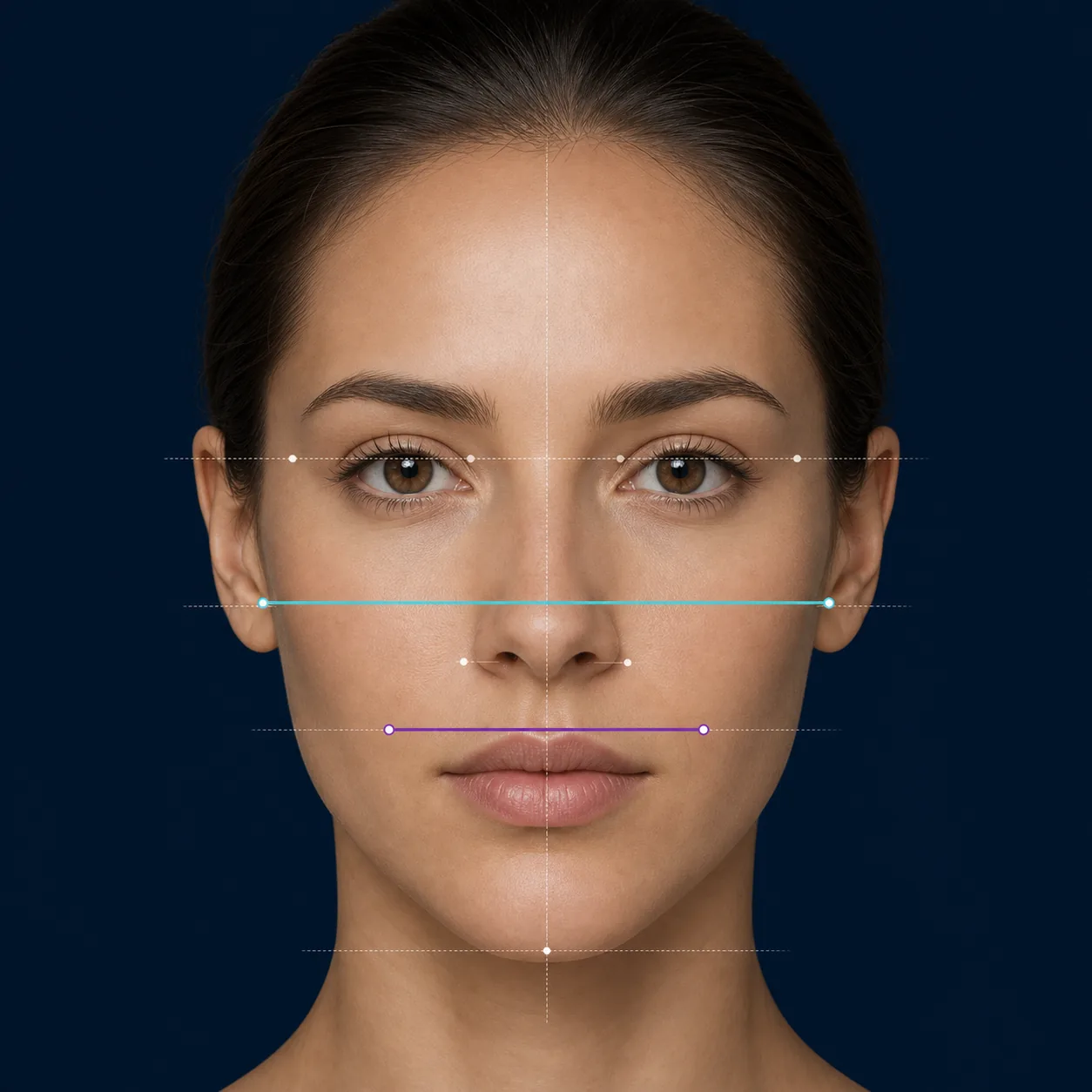
Before comparing a number
- Name the landmarks: Record the exact top, bottom, and width points used.
- Keep the formula: Do not compare results produced by different denominators.
- Keep the photo setup: Use the same camera distance, lens, head position, crop, and expression.
How to measure midface ratio from a photo
Start with a straight-on portrait taken at a normal portrait distance. Place the camera near eye level, keep the head upright, use a relaxed expression, and make sure both ears or both sides of the jaw are similarly visible. Avoid wide-angle selfies because the nose and central face can be enlarged relative to the outer face.
Choose one formula and mark its landmarks. For a width-based educational comparison, you might measure a vertical span from the pupil line to the upper-lip line and divide it by the center-to-center pupil distance. For a facial-thirds comparison, measure the defined middle third and divide it by the lower third. The result has value only when the same method is repeated.
Measure in pixels rather than centimeters. A ratio removes the need to know the physical scale of the image. Repeat the placement three times and use the average if you want a more stable personal comparison. Small changes of a few pixels can matter when the image is low resolution.
Simple measurement workflow
- 1. Standardize: Use an uncropped, level, front-facing portrait without beauty filters.
- 2. Mark: Place the same landmarks on every image.
- 3. Divide: Calculate vertical distance divided by the selected comparison distance.
- 4. Repeat: Re-measure and compare only photos created under similar conditions.
Why camera distance and head position change the ratio
A face is three-dimensional, while the measurement is usually made on a flat image. When a phone is close to the face, central features sit nearer to the lens than the ears and jaw. Perspective can make the nose look larger, the outer face narrower, and some vertical spans longer or shorter. Moving the camera back and cropping later usually produces a more neutral comparison.
Head pitch also changes landmark spacing. Tilting the chin down compresses some visible distances and hides the underside of the nose; lifting the chin can lengthen the lower face. Rotation makes one eye appear closer to the nose and can shift the apparent pupil distance. Even a strong smile raises the cheeks and changes the upper-lip line.
This is why a single selfie should not be treated as a stable facial measurement. If your result changes between photos, first suspect the image setup before assuming your proportions changed.
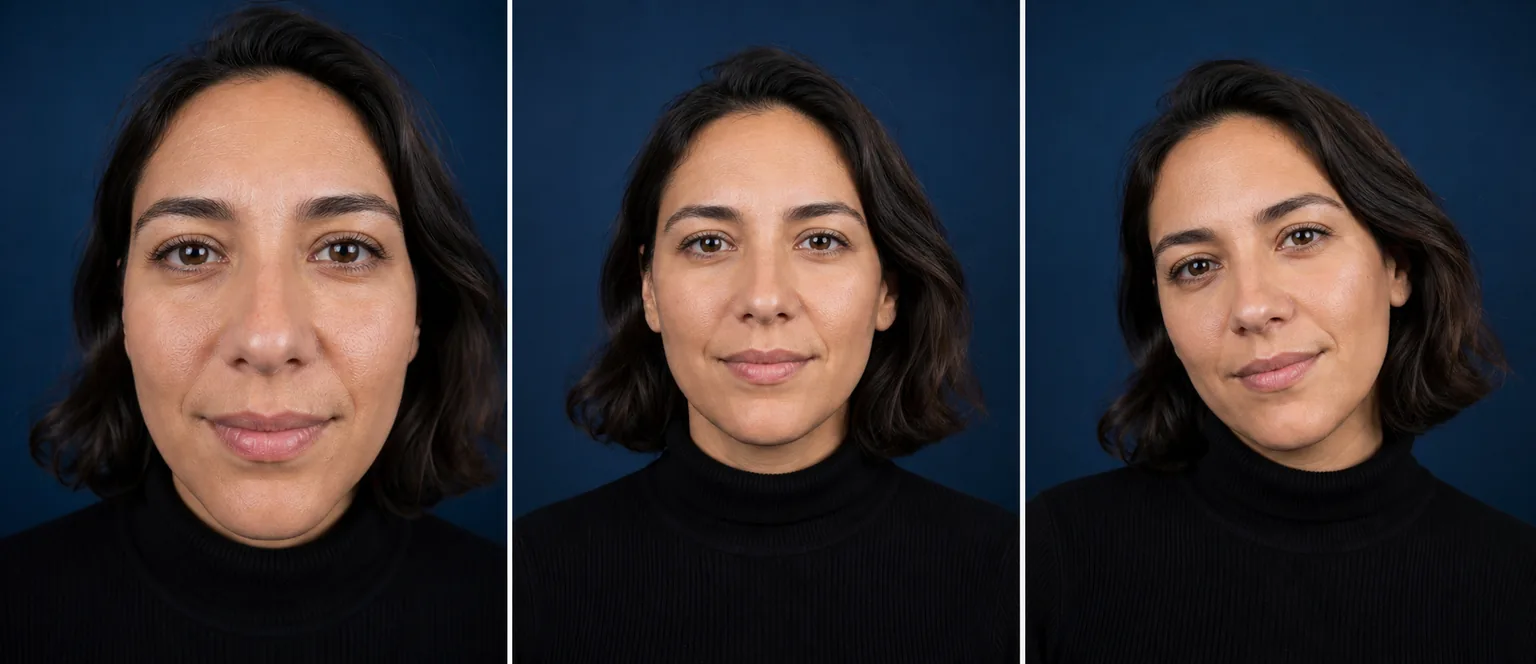
Largest sources of error
- Wide-angle selfie: Exaggerates central features and reduces the apparent outer-face width.
- Head tilt or rotation: Moves landmarks out of a shared plane and changes visible distances.
- Expression: Changes cheek height, lip position, eye opening, and chin tension.
- Hair and crop: Can hide the upper-face reference points or make the face look longer or shorter.
How to interpret a short, average, or long midface
A relatively short-looking midface often creates a compact impression, especially when the eyes, nose, and mouth appear close together. A relatively long-looking midface creates more vertical space through the nose and cheek region. Neither description is automatically positive or negative. It interacts with face width, lower-face length, eye size, cheekbone position, profile, and expression.
Avoid treating a decimal as a beauty grade. Online “ideal” ranges frequently mix formulas, edited celebrity images, and measurements taken from different lens distances. A more useful interpretation is descriptive: which region appears dominant, whether the photo is standardized, and how the ratio relates to other visible proportions.
If you are using the result for styling, practical changes such as eyebrow shape, hairstyle volume, glasses depth, facial hair, blush placement, or camera height can alter emphasis without pretending to change bone structure. For medical, dental, or surgical concerns, use a qualified professional rather than an online photo ratio.
Better questions than “Is my ratio good?”
- Is the photo neutral: Check perspective and head position first.
- Which definition is used: Confirm whether the comparison is width-based or thirds-based.
- What is the goal: Separate curiosity, photo feedback, styling, and clinical concerns.
Does midface ratio determine attractiveness?
No single midface ratio determines attractiveness. Research on facial appeal more often examines combinations such as symmetry, averageness, sexual dimorphism, skin cues, feature spacing, and overall configuration. Even when a proportional tendency appears in a study, it describes group averages under specific methods—not a universal threshold for an individual.
The midface can influence the character of a face, but observers see the whole face at once. Eye shape, brows, nose, lips, jaw, cheek projection, skin, expression, movement, and familiarity all contribute. Cultural exposure and personal preference also affect which proportions feel balanced or distinctive.
Use midface ratio as vocabulary for understanding a photograph, not as a self-worth score. If appearance analysis makes you repeatedly measure, compare, or avoid normal photos, stepping away from ratios is more useful than finding another calculator.
What the number can and cannot do
- Can: Describe one relationship in a controlled front-facing image.
- Can: Help compare camera setups or styling emphasis for the same person.
- Cannot: Prove health, character, worth, or universal attractiveness.
- Cannot: Replace three-dimensional clinical evaluation.
Midface measurements compared
These methods overlap in topic but should not share one benchmark.
| Method | Typical landmarks | Best use | Main limitation |
|---|---|---|---|
| Width-based online ratio | Eye or pupil line to lip/nose point ÷ pupil distance | Repeatable photo comparison | Endpoints vary widely online |
| Facial thirds | Brow/glabella to nose base compared with nose base to chin | Vertical proportion description | Hairline and soft-tissue landmarks vary |
| Clinical anthropometry | Defined anatomical landmarks measured under a protocol | Professional assessment and research | Requires training and population context |
| Visual impression | No fixed landmarks | Styling and photo feedback | Subjective and strongly context-dependent |
Midface ratio FAQ
Compare proportions without reducing your face to one number
Use the facial-thirds and facial-harmony guides to place midface ratio inside a broader, more useful picture. If you test a photo, standardize the camera setup first.
Research context
- Farkas and colleagues: anthropometric landmark methods for describing human facial proportions.
- Rhodes (2006): review of facial attractiveness research including averageness, symmetry, and configuration.
- Clinical facial-aesthetics literature uses defined landmarks and population context; it does not establish one universal social-media midface score.