Golden Ratio Face: Measurements, Meaning, and Limits
A practical, evidence-aware guide to the 1.618 face ratio, common measurement landmarks, and the difference between proportion, symmetry, and facial harmony.

Written By
Clara Vale
Beauty technology writer focused on explaining facial analysis without turning one measurement into a verdict.
Editorial Note
Facial ratios describe geometry in one image. They do not measure health, character, worth, or universal beauty.
Quick answer
A golden ratio face is a face whose selected distances are compared with the mathematical ratio 1.618. Guides may compare face height with width, mouth width with nose width, or spacing between major landmarks. There is no single universally accepted facial golden-ratio formula.
The method is best used as a descriptive proportion exercise. It can help you notice balance in a straight, well-lit photo, but it should not be treated as an objective beauty score or a reason to change your appearance.
What is a golden ratio face?
The golden ratio, often written as phi or 1.618, appears when lengths share a particular relationship. Designers and artists use it because it can create visual rhythm.
Applied to faces, the phrase does not describe one official mask. Different calculators choose different landmarks, crops, and formulas, so two tools can produce different results from the same photo.
What the phrase usually includes
- Overall shape: Face height compared with face width.
- Feature spacing: Distances between eyes, nose, mouth, brows, and chin.
- Nested ratios: A smaller feature distance compared with a larger facial distance.
- Photo assumptions: A centered head, neutral expression, and limited lens distortion.
Common golden ratio face measurements
Most guides start with landmarks that are easy to identify: hairline, brow line, pupils, nose base, mouth corners, cheek edges, and chin. A calculator divides one distance by another and compares the result with 1.618 or its inverse, about 0.618.
These choices are conventions, not natural laws. Hairlines vary, expressions change mouth and eye measurements, and a useful tool should show exactly which points it uses instead of returning a mysterious percentage.
A recent facial-proportion study found preferred ratios that did not simply reproduce the classical golden ratio. See the PubMed abstract . A broader review is available in this open-access review.
| Measurement | What it compares | How to interpret it |
|---|---|---|
| Face height ÷ face width | Overall vertical-to-horizontal proportion | Sensitive to hairline, chin point, and crop. |
| Mouth width ÷ nose width | Central lower-face features | Expression can change mouth width. |
| Eye spacing ÷ eye width | Distance between the eyes relative to one eye | Requires precise landmarks. |
| Nose-to-chin ÷ lip-to-chin | Nested lower-face distances | Pose and lip position alter the result. |
How to check facial ratios from a photo
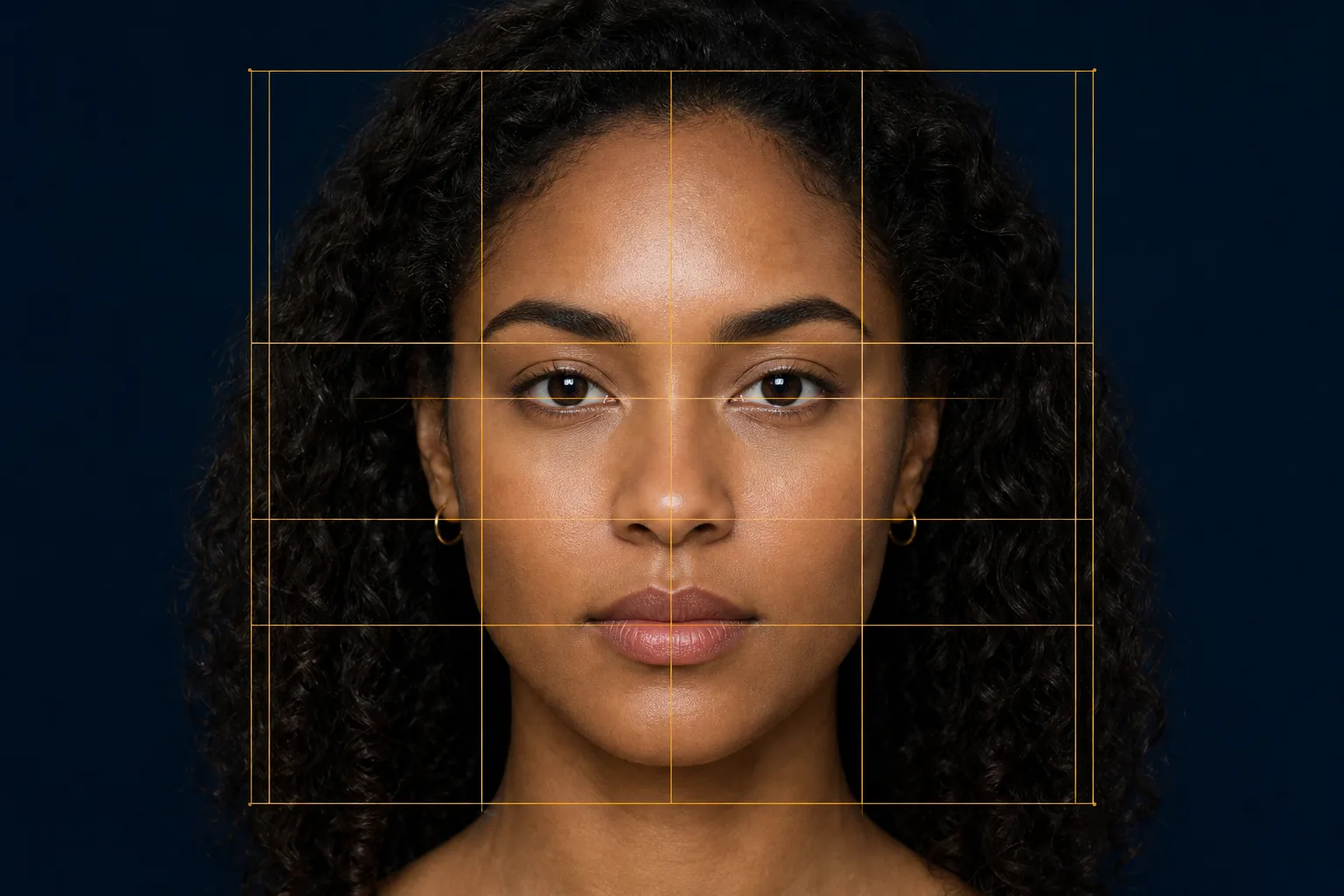
Use a front-facing photo taken at eye level. Keep the camera several feet away, use even lighting, remove strong filters, and avoid a wide-angle selfie close to the face. Keep the head upright and expression relaxed.
Mark the same landmarks on both sides, measure in pixels, and compare ratios rather than raw sizes. Repeat with a second photo before drawing conclusions because pose, hair, shadow, and perspective can move the result.
| Variable | Possible effect | Better practice |
|---|---|---|
| Wide-angle selfie | Enlarges central features | Move the camera farther away. |
| Head tilt | Changes vertical distances | Keep eyes level. |
| Smile | Widens the mouth and lifts cheeks | Use a relaxed expression. |
| Uneven light | Hides edges and landmarks | Use soft frontal light. |
Golden ratio vs facial symmetry and facial thirds
The golden ratio compares selected lengths. Facial symmetry compares the left and right sides. Facial thirds divide the face vertically into upper, middle, and lower zones. Facial harmony asks whether features look coherent together.
A person can have noticeable asymmetry and still have balanced proportions. Another can have near-even thirds without matching 1.618. Treat these frameworks as separate lenses, not interchangeable scores.
| Framework | Main question | Best use |
|---|---|---|
| Golden ratio | How do selected lengths relate? | Learning proportional relationships. |
| Symmetry | How similar are left and right? | Spotting pose or side differences. |
| Facial thirds | How are vertical zones balanced? | Understanding vertical composition. |
| Facial harmony | Do features work together? | Combining measurements with context. |
Why the golden ratio is not a universal beauty rule
Research finds that proportion can matter, but preferred ratios do not always equal the classical golden ratio. Preferences also shift with population, sex, age, expression, familiarity, culture, and the image used.
Similarity to a template does not prove that a face is more attractive to every viewer. It cannot account for movement, voice, warmth, grooming, style, or real interaction.
Red flags in online claims
- One perfect mask: A single overlay is presented as valid for every face.
- Exact beauty percentage: The tool hides its landmarks but reports scientific-looking precision.
- Celebrity certainty: Unverified measurements are treated as objective rankings.
- Change pressure: A descriptive ratio is used to push cosmetic decisions.
A healthier way to use face ratios
Use ratios to understand composition, compare photo conditions, or learn why two images of the same person can feel different. Read an attractiveness test as feedback about one image rather than a permanent label.
Combine proportion notes with facial symmetry, facial thirds, expression, lighting, and image quality. A specific observation such as “the camera angle shortens the lower third” is more useful than saying a face is wrong.

A five-step workflow
- Standardize: Choose a front-facing, evenly lit photo.
- Mark: Use consistent landmarks and document them.
- Compare: Check several ratios instead of one headline number.
- Repeat: Use another photo to test stability.
- Contextualize: Compare with symmetry, thirds, and photo quality.
Golden ratio face FAQ
Use proportions as context, not a verdict
Try the attractiveness test with a clear front-facing image, then compare the result with the facial harmony and facial thirds guides.
Research notes
- Estrela et al. (2023), analysis of facial proportionality using a modified golden ratio.
- Rhodes (2006), review of symmetry, averageness, and facial proportions.